Application
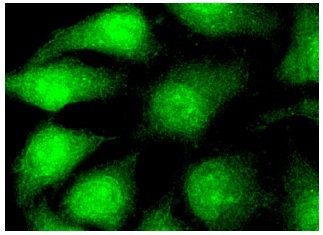
Immunofluorescence staining of methanol-fixed HeLa cells showing nuclear and cytoplasmic localization.| Product Name | FANCA Antibody (H-300) |
|---|---|
| Antibody Type | Primary Antibodies |
| Antigen Alias | epitope corresponding to amino acids 1156-1455 of FANCA of human origin |
| Modification Notes | Fanconi anemia (FA) is an autosomal recessive disorder characterized by bone marrow failure, birth defects and chromosomal instability. At the cellular level, FA is characterized by spontaneous chromosomal breakage and a unique hypersensitivity to DNA cross-linking agents. At least eight complementation groups (A-G) have been identified and six FA genes (for subtypes A, C, D2, E, F and G) have been cloned. The FA proteins lack sequence homologies or motifs that could point to a molecular function. The cellular accumulation of FA proteins, including FANCA and FANCG, is subject to regulation by TNFå signaling. Phosphorylation of FANC (Fanconi anemia complementation group) proteins is thought to be important for the function of the FA pathway. FANCA, also known as FACA and FANCH, associates with the Brm-related gene 1 (BRG1) product, a subunit of the SWI/SNF complex which remodels chromatin structure through a DNA-dependent ATPase activity. FANCA is mainly expressed in lymphoid tissues, testis and ovary. The amino-terminal region of the FANCA protein is required for FANCG binding, FANCC binding, nuclear localization and functional activity of the complex. The human FANCA gene maps to chromosome 16q24.3 and encodes a 1,455 amino acid protein. |
| Clonality | Polyclonal |
|---|---|
| Isotype | IgG |
| Host Species | Rabbit |
| Tested Applications | WBIPIFELISA |
| recommended for detection of FANCA of human and, to a lesser extent, mouse and rat origin by WB, IP, IF and ELISA: |
|
| Species Reactivity | HumanMouseRat |
| Concentration | 1mg/ml |
| Purification | Affinity purified |
| Alternative Names | epitope corresponding to amino acids 1156-1455 of FANCA of human origin |
|---|---|
| Tissue Specificity | epitope corresponding to amino acids 1156-1455 of FANCA of human origin |
| Entrez Gene | 2175 |
|---|
Application
Immunofluorescence staining of methanol-fixed HeLa cells showing nuclear and cytoplasmic localization.| Application Notes | recommended for detection of FANCA of human and, to a lesser extent, mouse and rat origin by WB, IP, IF and ELISA: |
|---|
| Form | Liquid |
|---|---|
| Storage Instructions | For short-term storage, store at 4° C. For long-term storage, aliquot and store at -20ºC or below. Avoid multiple freeze-thaw cycles. |
| Storage Buffer | phosphate buffered saline , pH 7.4, 150mM NaCl, 0.02% sodium azide and 50% glycerol. |


