Application
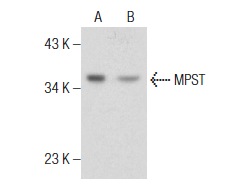
Western blot analysis of MPST expression in HEK293 (A) and HeLa (B) whole cell lysates.| Product Name | MPST Antibody (H-49) |
|---|---|
| Antibody Type | Primary Antibodies |
| Antigen Alias | epitope corresponding to amino acids 117-165 mapping within an internal region of MPST of human origin |
| Modification Notes | MPST (mercaptopyruvate sulfurtransferase), also known as MST or TST2, is a 297 amino acid protein that localizes to the cytoplasm and contains two rhodanese domains. Existing as a monomer or as a dilsulfide-linked homodimer, MPST functions to catalyze the transfer of a sulfur ion to select thiol compounds, such as cyanide, and is thought to be involved in cyanide detoxification and cysteine degradation. MPST deficiency may be associated with the pathogenesis of the rare disorder mercaptolactate-cysteine disulfiduria (MCDU). The gene encoding MPST maps to human chromosome 22, which houses over 500 genes and is the second smallest human chromosome. Mutations in several of the genes that map to chromosome 22 are involved in the development of Phelan-McDermid syndrome, Neurofibromatosis type 2, autism and schizophrenia. |
| Clonality | Polyclonal |
|---|---|
| Isotype | IgG |
| Host Species | Rabbit |
| Tested Applications | WBIPIFELISA |
| recommended for detection of MPST of human, mouse and, to a lesser extent, rat origin by WB, IP, IF and ELISA also reactive with additional species, including equine: |
|
| Species Reactivity | HumanMouseRat |
| Concentration | 1mg/ml |
| Purification | Affinity purified |
| Alternative Names | epitope corresponding to amino acids 117-165 mapping within an internal region of MPST of human origin |
|---|---|
| Tissue Specificity | epitope corresponding to amino acids 117-165 mapping within an internal region of MPST of human origin |
| Entrez Gene | 4357 |
|---|
Application
Western blot analysis of MPST expression in HEK293 (A) and HeLa (B) whole cell lysates.| Application Notes | recommended for detection of MPST of human, mouse and, to a lesser extent, rat origin by WB, IP, IF and ELISA also reactive with additional species, including equine: |
|---|
| Form | Liquid |
|---|---|
| Storage Instructions | For short-term storage, store at 4° C. For long-term storage, aliquot and store at -20ºC or below. Avoid multiple freeze-thaw cycles. |
| Storage Buffer | phosphate buffered saline , pH 7.4, 150mM NaCl, 0.02% sodium azide and 50% glycerol. |


