Application
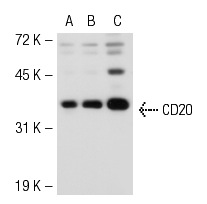
Western blot analysis of CD20 expression in non-transfected 293T: (A), mouse CD20 transfected 293T: (B) and Jurkat (C) whole cell lysates.Application
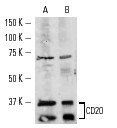
Western blot analysis of CD20 expression in BJAB (A) and Ramos (B) whole cell lysates.| Product Name | CD20 Antibody (H-170) |
|---|---|
| Antibody Type | Primary Antibodies |
| Antigen Alias | epitope corresponding to amino acids 1-170 of CD20 (B-lymphocyte surface antigen) of human origin |
| Modification Notes | CD20 is a leukocyte surface antigen consisting of four transmembrane regions and cytoplasmic N- and C-termini. The cytoplasmic domain of CD20 contains multiple phosphorylation sites, leading to additional isoforms. CD20 is expressed primarily on B cells but has also been detected on both normal and neoplastic T cells (2). CD20 functions as a calcium-permeable cation channel, and it is known to accelerate the G0 to G1 progression induced by IGF-1 (3). CD20 is activated by the IGF-1 receptor via the alpha subunits of the heterotrimeric G proteins (4). Activation of CD20 significantly increases DNA synthesis and is thought to involve basic helix-loop-helix leucine zipper transcription factors (5,6). |
| Clonality | Polyclonal |
|---|---|
| Isotype | IgG |
| Host Species | Rabbit |
| Tested Applications | WBIPIFELISA |
| recommended for detection of CD20 of mouse, rat and human origin by WB, IP, IF and ELISA: WB:1:100~1:200 IF:1:20~1:100 ELISA:1:1000~1:5000 IP:1:20~1:100 |
|
| Species Reactivity | HumanMouseRat |
| Concentration | 1mg/ml |
| Purification | Affinity purified |
| Alternative Names | epitope corresponding to amino acids 1-170 of CD20 (B-lymphocyte surface antigen) of human origin |
|---|---|
| Tissue Specificity | epitope corresponding to amino acids 1-170 of CD20 (B-lymphocyte surface antigen) of human origin |
| Entrez Gene | 931 |
|---|
Application
Western blot analysis of CD20 expression in non-transfected 293T: (A), mouse CD20 transfected 293T: (B) and Jurkat (C) whole cell lysates.
Application
Western blot analysis of CD20 expression in BJAB (A) and Ramos (B) whole cell lysates.| Application Notes | recommended for detection of CD20 of mouse, rat and human origin by WB, IP, IF and ELISA: WB:1:100~1:200 IF:1:20~1:100 ELISA:1:1000~1:5000 IP:1:20~1:100 |
|---|
| Form | Liquid |
|---|---|
| Storage Instructions | For short-term storage, store at 4° C. For long-term storage, aliquot and store at -20ºC or below. Avoid multiple freeze-thaw cycles. |
| Storage Buffer | phosphate buffered saline , pH 7.4, 150mM NaCl, 0.02% sodium azide and 50% glycerol. |


