Application
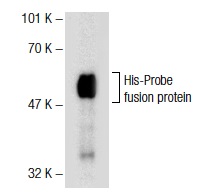
Western blot analysis of mouse recombinant RIP140 fusion protein.Application
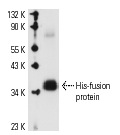
Western blot analysis of His-tagged fusion protein.| Product Name | His-probe Antibody (G-18) |
|---|---|
| Antibody Type | Primary Antibodies |
| Antigen Alias | recommended for detection of fusion proteins encoded py pET expression vectors with polyhistidine sequence domains by WB, IP and ELISA |
| Modification Notes | Plasmid vectors for the expression of coding regions of eukaryotic genes in bacterial, insect and mammalian hosts are in common usage; such expression vectors are frequently used to encode hybrid fusion proteins consisting of a eukaryotic target protein and a specialized region designed to aid in the purification and visualization of the target protein. A system that has proven to be very successful relies on the insertion of a six histidine (His6) sequence in the N-terminus of the encoded protein, allowing for efficient coupling to Ni2+-chelating resins and purification by single step affinity chromatography. This polyhistidine sequence can then be removed by specific cleavage at sites recognized by enzymes such as thrombin or enterokinase, permitting the separation of the target protein from the polyhistidine tag. Visualization of such fusion proteins can be achieved by utilizing antibodies generated against specific peptide sequences downstream from the multiple cloning site. |
| Clonality | Polyclonal |
|---|---|
| Isotype | IgG |
| Host Species | Rabbit |
| Tested Applications | WBIPELISA |
| blocking peptide, sc-804 P: |
|
| Species Reactivity | HumanMouseRat |
| Concentration | 1mg/ml |
| Purification | Affinity purified |
| Alternative Names | recommended for detection of fusion proteins encoded py pET expression vectors with polyhistidine sequence domains by WB IP and ELISA |
|---|---|
| Tissue Specificity | recommended for detection of fusion proteins encoded py pET expression vectors with polyhistidine sequence domains by WB, IP and ELISA |
Application
Western blot analysis of mouse recombinant RIP140 fusion protein.
Application
Western blot analysis of His-tagged fusion protein.| Application Notes | blocking peptide, sc-804 P: |
|---|
| Form | Liquid |
|---|---|
| Storage Instructions | For short-term storage, store at 4° C. For long-term storage, aliquot and store at -20ºC or below. Avoid multiple freeze-thaw cycles. |
| Storage Buffer | phosphate buffered saline , pH 7.4, 150mM NaCl, 0.02% sodium azide and 50% glycerol. |


