Application
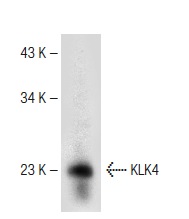
Western blot analysis of KLK4 expression in rat prostate tissue extract.| Product Name | KLK4 Antibody (H-50) |
|---|---|
| Antibody Type | Primary Antibodies |
| Antigen Alias | epitope corresponding to amino acids 155-204 mapping near the C-terminus of KLK4 of human origin |
| Modification Notes | Kallikreins (KLKs) belong to the serine protease family of proteolytic enzymes. Human pancreatic/renal KLK encodes for the KLK1 enzyme, which is involved in post-translational processing of polypeptide precursors. The function of the other members of KLK gene family is currently unknown, but evidence suggests that many KLKs are implicated in carcinogenesis (1–4). The human KLK gene family consists of 15 serine proteases (5). The human KLK genes are clustered on chromosome 19q13. Unlike other kalllikreins, the KLK4-15 encoded proteases are less related and do not contain a conventional KLK loop. Clusters of genes exhibit high prostatic (KLK2-4, KLK15) or pancreatic (KLK6-13) expression (2). KLK2 is also known as glandular kallikrein 2, tissue kallikrein, or HGK-1 and KLK3 is known as prostate-specific antigen (PSA). Both KLK2 and KLK3 have important applications in prostate cancer and breast cancer diagnostics. KLK4, KLK5, KLK9, KLK13, KLK12 and KLK14 have been previously known as KLK-L1, KLK-L2, KLK-L3, KLK-L4, KLK-L5 and KLK-L6, respectively. Many of the KLKs are regulated by steroid hormones and a few of them, specifically KLK3, KLK6 and KLK10, are known to be downregulated in breast and other cancers (6). |
| Clonality | Polyclonal |
|---|---|
| Isotype | IgG |
| Host Species | Rabbit |
| Tested Applications | WBIPIFELISA |
| recommended for detection of KLK4 of human and, to a lesser extent, mouse and rat origin by WB, IP, IF and ELISA: |
|
| Species Reactivity | HumanMouseRat |
| Concentration | 1mg/ml |
| Purification | Affinity purified |
| Alternative Names | epitope corresponding to amino acids 155-204 mapping near the C-terminus of KLK4 of human origin |
|---|---|
| Tissue Specificity | epitope corresponding to amino acids 155-204 mapping near the C-terminus of KLK4 of human origin |
| Entrez Gene | 9622 |
|---|
Application
Western blot analysis of KLK4 expression in rat prostate tissue extract.| Application Notes | recommended for detection of KLK4 of human and, to a lesser extent, mouse and rat origin by WB, IP, IF and ELISA: |
|---|
| Form | Liquid |
|---|---|
| Storage Instructions | For short-term storage, store at 4° C. For long-term storage, aliquot and store at -20ºC or below. Avoid multiple freeze-thaw cycles. |
| Storage Buffer | phosphate buffered saline , pH 7.4, 150mM NaCl, 0.02% sodium azide and 50% glycerol. |


