Application
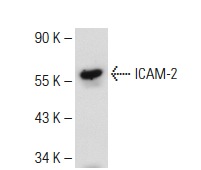
Western blot analysis of ICAM-2 expression in HL-60 whole cell lysate.Application
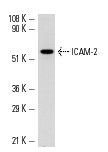
Western blot analysis of ICAM-2 expression in NAMALWA whole cell lysate.| Product Name | ICAM-2 Antibody (H-159) |
|---|---|
| Antibody Type | Primary Antibodies |
| Antigen Alias | epitope corresponding to amino acids 65-223 mapping within the extracellular domain of ICAM-2 of human origin |
| Modification Notes | Cell adhesion molecules are a family of closely related cell surface glycoproteins involved in cell-cell interactions during growth and are thought to play important, yet separate, roles in embryogenesis and development. The intracellular adhesion molecule-1 (ICAM-1), also referred to as CD54, is an integral membrane protein of the immunoglobulin superfamily and recognizes the b2a1 and b2aM Integrins. ICAM-2 functions as a ligand for lymphocyte function-associated antigen-1 (LFA-1) and is involved in leukocyte adhesion. ICAM-3 is highly expressed on the surface of human eosinophils, and when bound to ligand may inhibit eosinophil inflammatory responses and survival. ICAM-4, also known as LW glycoprotein, interacts with Integrins aLb2, aMb2, a4b1, the aV family and aIIbb3, and selective binding to different integrins may be relevant to the pathology in a number of red blood cell associated diseases. Lastly, ICAM-5, expressed on telencephalic neurons, binds CD11a/CD18 and thus may act as an adhesion molecule for leukocyte binding in the central nervous system. |
| Clonality | Polyclonal |
|---|---|
| Isotype | IgG |
| Host Species | Rabbit |
| Tested Applications | WBIPIFELISA |
| recommended for detection of ICAM-2 of mouse, rat and human origin by WB, IP, IF and ELISA: |
|
| Species Reactivity | HumanMouseRat |
| Concentration | 1mg/ml |
| Purification | Affinity purified |
| Alternative Names | epitope corresponding to amino acids 65-223 mapping within the extracellular domain of ICAM-2 of human origin |
|---|---|
| Tissue Specificity | epitope corresponding to amino acids 65-223 mapping within the extracellular domain of ICAM-2 of human origin |
| Entrez Gene | 3384 |
|---|
Application
Western blot analysis of ICAM-2 expression in HL-60 whole cell lysate.
Application
Western blot analysis of ICAM-2 expression in NAMALWA whole cell lysate.| Application Notes | recommended for detection of ICAM-2 of mouse, rat and human origin by WB, IP, IF and ELISA: |
|---|
| Form | Liquid |
|---|---|
| Storage Instructions | For short-term storage, store at 4° C. For long-term storage, aliquot and store at -20ºC or below. Avoid multiple freeze-thaw cycles. |
| Storage Buffer | phosphate buffered saline , pH 7.4, 150mM NaCl, 0.02% sodium azide and 50% glycerol. |


