Application
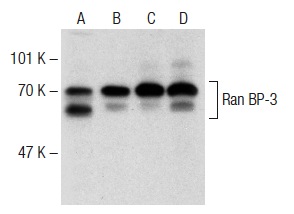
Western blot analysis of Ran BP-3 expression in SHP-77 (A), U-937 (B), Y79 (C) and Jurkat (D) whole cell lysates.| Product Name | Ran BP-3 Antibody (H-144) |
|---|---|
| Antibody Type | Primary Antibodies |
| Antigen Alias | epitope corresponding to amino acids 101-244 mapping within an internal region of Ran BP-3 of human origin |
| Modification Notes | The small Ras-related protein Ran, also called TC4, is a nuclear localized GTPase implicated in a diverse array of cellular processes including DNA replication, entry into and exit from mitosis and the transport of RNA and proteins through the nuclear pore complex. Like Ras, active Ran GTP and inactive Ran GDP levels are tightly regulated by guanine nucleotide exchange factors (GEFs) and GTPase activating proteins (GAPs). The abundant GEF, RCC1 (regulator of chromosome condensation 1), increases the rate at which Ran exchanges GDP for GTP. Ran BP-3 acts as a scaffold protein to promote the efficient assembly of export complexes. Specifically, Ran BP-3 promotes binding of Crm1 to RCC1 in the presence of Ran. Ran BP-3 has also been shown to bind ∫-catenin, thereby inhibiting the Wnt signaling pathway. |
| Clonality | Polyclonal |
|---|---|
| Isotype | IgG |
| Host Species | Rabbit |
| Tested Applications | WBIPIFELISA |
| recommended for detection of Ran BP-3 of human and, to a lesser extent, mouse and rat origin by WB, IP, IF and ELISA also reactive with additional species, including equine and canine: |
|
| Species Reactivity | HumanMouseRat |
| Concentration | 1mg/ml |
| Purification | Affinity purified |
| Alternative Names | epitope corresponding to amino acids 101-244 mapping within an internal region of Ran BP-3 of human origin |
|---|---|
| Tissue Specificity | epitope corresponding to amino acids 101-244 mapping within an internal region of Ran BP-3 of human origin |
Application
Western blot analysis of Ran BP-3 expression in SHP-77 (A), U-937 (B), Y79 (C) and Jurkat (D) whole cell lysates.| Application Notes | recommended for detection of Ran BP-3 of human and, to a lesser extent, mouse and rat origin by WB, IP, IF and ELISA also reactive with additional species, including equine and canine: |
|---|
| Form | Liquid |
|---|---|
| Storage Instructions | For short-term storage, store at 4° C. For long-term storage, aliquot and store at -20ºC or below. Avoid multiple freeze-thaw cycles. |
| Storage Buffer | phosphate buffered saline , pH 7.4, 150mM NaCl, 0.02% sodium azide and 50% glycerol. |


