Application
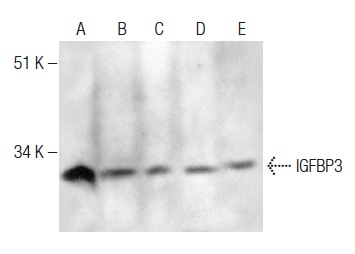
Western blot analysis of IGFBP3 expression in MIA PaCa-2 (A), JAR (B), HUV-EC-C (C) and HT-1080 (D) whole cell lysates and human adrenal gland tissue extract (E).Application
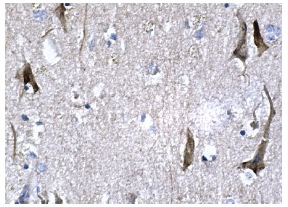
Immunoperoxidase staining of formalin fixed, paraffin-embedded human brain tissue showing cytoplasmic staining of neuronal cells.Application
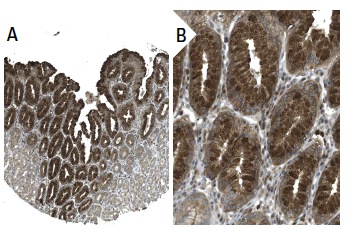
Immunoperoxidase staining of formalin fixed, paraffin-embedded human stomach tissue showing cytoplasmic staining of glandular cells (low and high magnification). Kindly provided by The Swedish Human Protein Atlas (HPA) program.Application
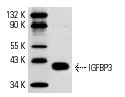
Western blot analysis of human recombinant IGFBP3.Application
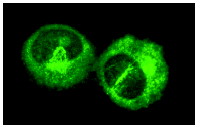
Immunofluorescence staining of methanol-fixed MIA PaCa-2 cells showing cytoplasmic localization.| Product Name | IGFBP3 Antibody (H-98) |
|---|---|
| Antibody Type | Primary Antibodies |
| Antigen Alias | epitope corresponding to amino acids 113-210 of insulin-like growth factor binding protein 3 (IGFBP3) of human origin |
| Modification Notes | The insulin-like growth factor-binding proteins, or IGFBPs, are a family of homologous proteins that have co-evolved with the IGFs. They serve not only as shuttle molecules for the soluble IGFs, but also confer a level of regulation to the IGF signaling system. Physical association of the IGFBPs with IGF influences the bio-availability of the growth factors, as well as their concentration and distribution in the extracellular environment. In addition, the IGFBPs appear to have biological activity independent of the IGFs. Seven IGFBPs have thus far been described, each differing in their tissue distribution, half-lives and modulation of IGF interactions with their receptors. For instance, IGFBP1 is negatively regulated by insulin production. The IGFBP1 gene is expressed at a high level during fetal liver development and in response to nutritional changes and diabetes. It has been suggested that IGFBP2 functions as chaperone, escorting IGFs to their target tissues. It is expressed in several human tissues including fetal eye and fetal brain. IGFBP3 is the most abundant IGFBP and is complexed with roughly 80% of the serum IGFs. Both IGFBP3 and IGFBP4 are released by dermal fibroblasts in response to incision injury. IGFBP5 is secreted by myoblasts and may play a key role in muscle differentiation. IGFBP6 differs from other IGFBPs in having the highest affinity for IGF-II. Glycosylated human IGFBP6 is expressed in Chinese hamster ovary (CHO) cells, whereas nonglycosylated recombinant human IGFBP6 is expressed in E.coli. IGFBP7 is a secreted protein and binds both IGF-I and IGF-II with a relatively low affinity. It stimulates prostacyclin production and may also function as a growth-suppressing factor. |
| Clonality | Polyclonal |
|---|---|
| Isotype | IgG |
| Host Species | Rabbit |
| Tested Applications | WBIPIFIHCELISA |
| recommended for detection of IGFBP3 of mouse, rat and human origin by WB, IP, IF, IHC(P) and ELISA: |
|
| Species Reactivity | HumanMouseRat |
| Concentration | 1mg/ml |
| Purification | Affinity purified |
| Alternative Names | epitope corresponding to amino acids 113-210 of insulin-like growth factor binding protein 3 (IGFBP3) of human origin |
|---|---|
| Tissue Specificity | epitope corresponding to amino acids 113-210 of insulin-like growth factor binding protein 3 (IGFBP3) of human origin |
| Entrez Gene | 3486 |
|---|
Application
Western blot analysis of IGFBP3 expression in MIA PaCa-2 (A), JAR (B), HUV-EC-C (C) and HT-1080 (D) whole cell lysates and human adrenal gland tissue extract (E).
Application
Immunoperoxidase staining of formalin fixed, paraffin-embedded human brain tissue showing cytoplasmic staining of neuronal cells.
Application
Immunoperoxidase staining of formalin fixed, paraffin-embedded human stomach tissue showing cytoplasmic staining of glandular cells (low and high magnification). Kindly provided by The Swedish Human Protein Atlas (HPA) program.
Application
Western blot analysis of human recombinant IGFBP3.
Application
Immunofluorescence staining of methanol-fixed MIA PaCa-2 cells showing cytoplasmic localization.| Application Notes | recommended for detection of IGFBP3 of mouse, rat and human origin by WB, IP, IF, IHC(P) and ELISA: |
|---|
| Form | Liquid |
|---|---|
| Storage Instructions | For short-term storage, store at 4° C. For long-term storage, aliquot and store at -20ºC or below. Avoid multiple freeze-thaw cycles. |
| Storage Buffer | phosphate buffered saline , pH 7.4, 150mM NaCl, 0.02% sodium azide and 50% glycerol. |


