Application
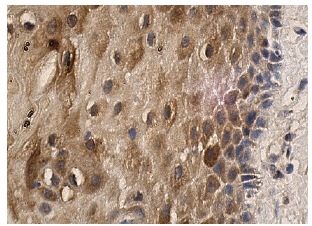
Immunoperoxidase staining of formalin fixed, paraffin-embedded human cervix tissue showing cytoplasmic staining of squamous epithelial cells.| Product Name | PBR Antibody (FL-169) |
|---|---|
| Antibody Type | Primary Antibodies |
| Antigen Alias | epitope corresponding to amino acids 1-169 representing full length of PBR of human origin |
| Modification Notes | Mitochondrial peripheral-type benzodiazepine receptor (PBR) is an indispensable element of the steroidogenic machinery, where it mediates the delivery of cholesterol to the inner mitochondrial side chain cleavage cytochrome P-450 upon ligand activation. PBR is composed of three subunits, an isoquinoline binding site, a voltage-dependent anion channel and an adenine nucleotide carrier. PBR is genetically conserved from bacteria to humans and in humans is widely expressed in peripheral organs, whereas in the brain, it is sparse and located mainly in glial cells. Peroxisome proliferator perfluordecanoic acid (PFDA) inhibits the Leydig cell steroidogenesis by affecting PBR mRNA stability, thus inhibiting PBR expression, cholesterol transport into the mitochondria and subsequent steroid formation. A cytoplasmic protein, PRAX-1 ( peripheral benzodiazepine receptor-associated protein 1), is found to specifically interact with PBR. The polypeptide diazepam binding inhibitor is an endogenous PBR ligand. PBR also binds Ro 5-4864 (4’-chlorodiazepam) and PK 11185 (an isoquinoline carboxamide derivative), but not clonazepam, and PBR regulates the cholesterol transport that results in decreased circulating corticosterone levels. |
| Clonality | Polyclonal |
|---|---|
| Isotype | IgG |
| Host Species | Rabbit |
| Tested Applications | WBIPIFIHCELISA |
| recommended for detection of PBR of mouse, rat and human origin by WB, IP, IF, IHC(P) and ELISA: |
|
| Species Reactivity | HumanMouseRat |
| Concentration | 1mg/ml |
| Purification | Affinity purified |
| Alternative Names | epitope corresponding to amino acids 1-169 representing full length of PBR of human origin |
|---|---|
| Tissue Specificity | epitope corresponding to amino acids 1-169 representing full length of PBR of human origin |
| Entrez Gene | 706 |
|---|
Application
Immunoperoxidase staining of formalin fixed, paraffin-embedded human cervix tissue showing cytoplasmic staining of squamous epithelial cells.| Application Notes | recommended for detection of PBR of mouse, rat and human origin by WB, IP, IF, IHC(P) and ELISA: |
|---|
| Form | Liquid |
|---|---|
| Storage Instructions | For short-term storage, store at 4° C. For long-term storage, aliquot and store at -20ºC or below. Avoid multiple freeze-thaw cycles. |
| Storage Buffer | phosphate buffered saline , pH 7.4, 150mM NaCl, 0.02% sodium azide and 50% glycerol. |


