Application
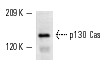
Western blot analysis of p130 Cas expression in HeLa whole cell lysate.| Product Name | p130 Cas Antibody (M-72) |
|---|---|
| Antibody Type | Primary Antibodies |
| Antigen Alias | epitope corresponding to amino acids 802-874 mapping at the C-terminus of p130 Cas of mouse origin |
| Modification Notes | p130 represents one of several known substrates for v-Crk encoded p47. p130 Cas (for Crk-associated substrate) exhibits a high level of tyrosine phosphorylation and is tightly associated with v-Crk, suggesting a role in v-Crk-mediated cell signaling. The molecular cloning of p130 Cas has shown it to represent a novel SH3 containing signaling molecule with a cluster of multiple putative SH2-binding motifs for v-Crk. By immunoprecipitation analysis, p130 Cas has been shown to be highly phosphorylated at tyrosine residues subsequent to either v-Src p60 or v-Crk-mediated transformation and to form stable complexes with both of these transforming proteins. p130 Cas behaves as an extremely potent substrate for protein tyrosine kinases and has been reported to relocate from the cytoplasm to cell membrane upon tyrosine phosphorylation. One proposed model is that the SH2 domain of v-Crk functions to activate c-Src kinase, which in turn phosphorylates p130 Cas. |
| Clonality | Polyclonal |
|---|---|
| Isotype | IgG |
| Host Species | Rabbit |
| Tested Applications | WBIPIFELISA |
| recommended for detection of p130 Cas of mouse, rat and human origin by WB, IP, IF and ELISA also reactive with additional species, including equine, canine and bovine: |
|
| Species Reactivity | HumanMouseRat |
| Concentration | 1mg/ml |
| Purification | Affinity purified |
| Alternative Names | epitope corresponding to amino acids 802-874 mapping at the C-terminus of p130 Cas of mouse origin |
|---|---|
| Tissue Specificity | epitope corresponding to amino acids 802-874 mapping at the C-terminus of p130 Cas of mouse origin |
| Entrez Gene | 9564 |
|---|
Application
Western blot analysis of p130 Cas expression in HeLa whole cell lysate.| Application Notes | recommended for detection of p130 Cas of mouse, rat and human origin by WB, IP, IF and ELISA also reactive with additional species, including equine, canine and bovine: |
|---|
| Form | Liquid |
|---|---|
| Storage Instructions | For short-term storage, store at 4° C. For long-term storage, aliquot and store at -20ºC or below. Avoid multiple freeze-thaw cycles. |
| Storage Buffer | phosphate buffered saline , pH 7.4, 150mM NaCl, 0.02% sodium azide and 50% glycerol. |


