Application
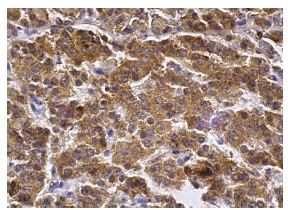
Immunoperoxidase staining of formalin fixed, paraffin-embedded human pancreas tissue showing cytoplasmic staining of glandular cells.Application
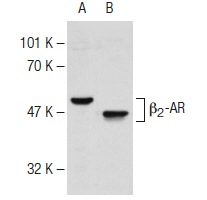
Western blot analysis of β2-AR expression in A-431 (A) and IMR-32 (B) nuclear extracts.| Product Name | β2-AR Antibody (H-73) |
|---|---|
| Antibody Type | Primary Antibodies |
| Antigen Alias | epitope corresponding to amino acids 338-413 mapping at the C-terminus of β2 adrenergic receptor of human origin |
| Modification Notes | Adrenergic receptors (ARs) (the term “adrenergic” reflects the alternative name for epinephrine, adrenaline) include four general types (a1, a2, b1 and b2) which are found in different target tissues and differ in their affinities and responses to various agonists and antagonists. cDNA clones have been isolated for all of the major AR subtypes and a number of closely related receptors have been identified by this approach. Each of the receptors have been shown to consist of single polypeptide chains which transverse the plasma membrane seven times, presumably forming a bundle of helices within the membrane. These transmembrane regions are hydrophobic and are interconnected by extracellular and intracellular hydrophilic loops. The coupling of ARs to specific intracellular effectors is mediated through diverse heterotrimeric G proteins and is regulated by G protein-coupled receptor kinases (GRKs), cAMP-dependent protein kinase A and protein kinase C directed phosphorylation. b2-adrenergic receptors bind cathecholamines (epinephrine, norepinephrine) and influence development, behavior, cardiac function, smooth muscle tone, and metabolism. b2-AR signaling complexes can contain C L-type calcium channel Ca(V)1.2, G protein, adenylyl cyclase, cAMP-dependent kinase, and PP2A phosphatase. b2-AR s are present in |
| Clonality | Polyclonal |
|---|---|
| Isotype | IgG |
| Host Species | Rabbit |
| Tested Applications | WBIPIFIHCELISA |
| recommended for detection of β2 adrenergic receptor of mouse, rat and human origin by WB, IP, IF, IHC(P) and ELISA: |
|
| Species Reactivity | HumanMouseRat |
| Concentration | 1mg/ml |
| Purification | Affinity purified |
| Alternative Names | epitope corresponding to amino acids 338-413 mapping at the C-terminus of &beta 2 adrenergic receptor of human origin |
|---|---|
| Tissue Specificity | epitope corresponding to amino acids 338-413 mapping at the C-terminus of β2 adrenergic receptor of human origin |
| Entrez Gene | 154 |
|---|
Application
Immunoperoxidase staining of formalin fixed, paraffin-embedded human pancreas tissue showing cytoplasmic staining of glandular cells.
Application
Western blot analysis of β2-AR expression in A-431 (A) and IMR-32 (B) nuclear extracts.| Application Notes | recommended for detection of β2 adrenergic receptor of mouse, rat and human origin by WB, IP, IF, IHC(P) and ELISA: |
|---|
| Form | Liquid |
|---|---|
| Storage Instructions | For short-term storage, store at 4° C. For long-term storage, aliquot and store at -20ºC or below. Avoid multiple freeze-thaw cycles. |
| Storage Buffer | phosphate buffered saline , pH 7.4, 150mM NaCl, 0.02% sodium azide and 50% glycerol. |


