Application
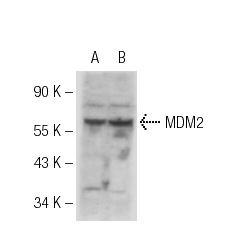
Western blot analysis of MDM2 expression in C2C12 (A), VA-ES-BJ (B), MES-SA/Dx5 (C) and A549 (D) whole cell lysates.Application
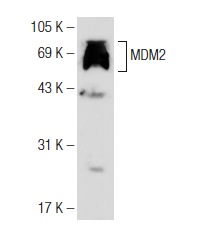
Western blot analysis of MDM2 expression in Jurkat whole cell lysate.| Product Name | MDM2 Antibody (H-221) |
|---|---|
| Antibody Type | Primary Antibodies |
| Antigen Alias | epitope corresponding to amino acids 100-320 of MDM2 of human origin |
| Modification Notes | p53 is the most commonly mutated gene in human cancer identified to date. Expression of p53 leads to inhibition of cell growth by preventing progression of cells from G1 to S phase of the cell cycle. Most importantly, p53 functions to cause arrest of cells in the G1 phase of the cell cycle following any exposure of cells to DNA-damaging agents. The MDM2 (murine double minute-2) protein was initially identified as an oncogene in a murine transformation system. MDM2 functions to bind p53 and block p53-mediated transactivation of cotransfected reporter constructs. The MDM2 gene is amplified in a high percentage of human sarcomas that retain wildtype p53 and tumor cells that overexpress MDM2 can tolerate high levels of p53 expression. These findings argue that MDM2 overexpression represents at least one mechanism by which p53 function can be abrogated during tumorigenesis. |
| Clonality | Polyclonal |
|---|---|
| Isotype | IgG |
| Host Species | Rabbit |
| Tested Applications | WBIPIFELISA |
| recommended for detection of MDM2 and MDM2 p60 cleavage product of mouse, rat and human origin by WB, IP, IF and ELISA also reactive with additional species, including equine, canine, bovine and porcine: |
|
| Species Reactivity | HumanMouseRat |
| Concentration | 1mg/ml |
| Purification | Affinity purified |
| Alternative Names | epitope corresponding to amino acids 100-320 of MDM2 of human origin |
|---|---|
| Tissue Specificity | epitope corresponding to amino acids 100-320 of MDM2 of human origin |
| Entrez Gene | 4193 |
|---|
Application
Western blot analysis of MDM2 expression in C2C12 (A), VA-ES-BJ (B), MES-SA/Dx5 (C) and A549 (D) whole cell lysates.
Application
Western blot analysis of MDM2 expression in Jurkat whole cell lysate.| Application Notes | recommended for detection of MDM2 and MDM2 p60 cleavage product of mouse, rat and human origin by WB, IP, IF and ELISA also reactive with additional species, including equine, canine, bovine and porcine: |
|---|
| Form | Liquid |
|---|---|
| Storage Instructions | For short-term storage, store at 4° C. For long-term storage, aliquot and store at -20ºC or below. Avoid multiple freeze-thaw cycles. |
| Storage Buffer | phosphate buffered saline , pH 7.4, 150mM NaCl, 0.02% sodium azide and 50% glycerol. |


