Application
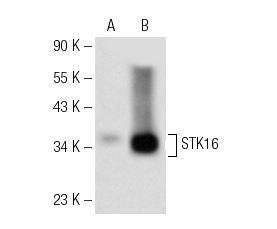
Western blot analysis of STK16 expression in non-transfected: (A) and human STK16 transfected: (B) 293T whole cell lysates.| Product Name | STK16 Antibody (H-80) |
|---|---|
| Antibody Type | Primary Antibodies |
| Antigen Alias | epitope corresponding to amino acids 226-305 mapping at the C-terminus of STK16 of human origin |
| Modification Notes | The phosphorylation of proteins by protein kinases and protein phosphatases is a key event in most nuclear and cytoplasmic processes. The ability to activate and deactivate proteins via phosphorylation or dephosphorylation is important for cell division, cell differentiation, DNA repair and transcription. STK16 (serine/threonine kinase 16), also known as KRCT, MPSK, TSF1 or PKL12, is a 305 amino acid lipid-anchored membrane protein that belongs to the superfamily of serine/threonine protein kinases. Expressed ubiquitously at low levels, STK16 is a protein kinase that can catalytically phosphorylate both serine and threonine residues on a variety of proteins. STK16 functions in an ATP-dependent manner and contains one protein kinase domain. Overexpression of STK16 causes disorganization of the Golgi apparatus, suggesting an additional role for STK16 in the secretory pathway. Human STK16 shares 94% sequence identity with its mouse counterpart, indicating a conserved function between species. |
| Clonality | Polyclonal |
|---|---|
| Isotype | IgG |
| Host Species | Rabbit |
| Tested Applications | WBIPIFELISA |
| recommended for detection of STK16 of mouse, rat and human origin by WB, IP, IF and ELISA also reactive with additional species, including equine, canine, bovine and porcine: |
|
| Species Reactivity | HumanMouseRat |
| Concentration | 1mg/ml |
| Purification | Affinity purified |
| Alternative Names | epitope corresponding to amino acids 226-305 mapping at the C-terminus of STK16 of human origin |
|---|---|
| Tissue Specificity | epitope corresponding to amino acids 226-305 mapping at the C-terminus of STK16 of human origin |
| Entrez Gene | 8576 |
|---|
Application
Western blot analysis of STK16 expression in non-transfected: (A) and human STK16 transfected: (B) 293T whole cell lysates.| Application Notes | recommended for detection of STK16 of mouse, rat and human origin by WB, IP, IF and ELISA also reactive with additional species, including equine, canine, bovine and porcine: |
|---|
| Form | Liquid |
|---|---|
| Storage Instructions | For short-term storage, store at 4° C. For long-term storage, aliquot and store at -20ºC or below. Avoid multiple freeze-thaw cycles. |
| Storage Buffer | phosphate buffered saline , pH 7.4, 150mM NaCl, 0.02% sodium azide and 50% glycerol. |


