Application
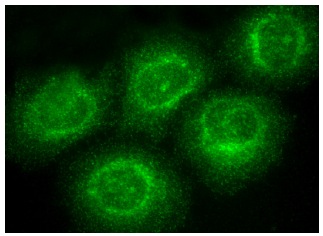
Immunofluorescence staining of methanol-fixed HeLa cells showing nuclear and cytoplasmic localization.Application
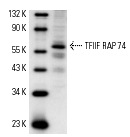
Western blot analysis of TFIIF RAP 74 expression in NIH/3T3 nuclear extract.| Product Name | TFIIF RAP 74 Antibody (C-18) |
|---|---|
| Antibody Type | Primary Antibodies |
| Antigen Alias | epitope mapping at the C-terminus of TFIIF RAP 74 of human origin |
| Modification Notes | In eukaryotic systems, initiation of transcription from protein-coding genes is a complex process requiring RNA polymerase II and broad families of auxiliary transcription factors. Such factors can be divided into two major functional classes: the basal factors that are required for transcription of all Pol II genes, including TFIIA, TFIIB, TFIID, TFIIE, TFIIF and TFIIH; and sequence-specific factors that regulate gene expression. The basal transcription factors and Pol II form a specific multiprotein complex near the transcription start site by interacting with core promotor elements such as the TATA box generally located 25-30 base pairs upstream of the transcription start site. TFIIF, a heteromer composed of a small (RAP 30) and a large (RAP 74) subunit, is required for RNA polymerase II to assemble into a preinitiation complex formed by promotor DNA and the general factors TFIID, IIA and IIB. In addition, TFIIF stimulates transcription elongation by RNA polymerase II. |
| Clonality | Polyclonal |
|---|---|
| Isotype | IgG |
| Host Species | Rabbit |
| Tested Applications | WBIPIFELISAGSChIP |
| recommended for detection of TFIIF RAP 74 of mouse, rat and human origin by WB, IP, IF and ELISA also reactive with additional species, including equine, canine, bovine and porcine: |
|
| Species Reactivity | HumanMouseRat |
| Concentration | 1mg/ml |
| Purification | Affinity purified |
| Alternative Names | epitope mapping at the C-terminus of TFIIF RAP 74 of human origin |
|---|---|
| Tissue Specificity | epitope mapping at the C-terminus of TFIIF RAP 74 of human origin |
| Entrez Gene | 2962 |
|---|
Application
Immunofluorescence staining of methanol-fixed HeLa cells showing nuclear and cytoplasmic localization.
Application
Western blot analysis of TFIIF RAP 74 expression in NIH/3T3 nuclear extract.| Application Notes | recommended for detection of TFIIF RAP 74 of mouse, rat and human origin by WB, IP, IF and ELISA also reactive with additional species, including equine, canine, bovine and porcine: |
|---|
| Form | Liquid |
|---|---|
| Storage Instructions | For short-term storage, store at 4° C. For long-term storage, aliquot and store at -20ºC or below. Avoid multiple freeze-thaw cycles. |
| Storage Buffer | phosphate buffered saline , pH 7.4, 150mM NaCl, 0.02% sodium azide and 50% glycerol. |


