Application
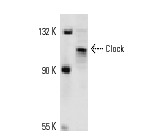
Western blot analysis of Clock expression in Sol8 whole cell lysate.| Product Name | Clock Antibody (H-276) |
|---|---|
| Antibody Type | Primary Antibodies |
| Antigen Alias | epitope corresponding to amino acids 571-846 of Clock of human origin |
| Modification Notes | Biological timepieces called circadian clocks are responsible for the regulation of hormonal rhythms, sleep cycles and other behaviors. The superchiasmatic nucleus (SCN), which is located in the brain, was the first mammalian circadian clock to be discovered (1). Clock, a member of the basic-helix-loop-helix-PAS (bHLH-PAS) family of transcription factors, has also been identified as having circadian function (2,5). Mutations within the Clock gene have been shown to increase the length of the endogenous period and to cause a loss of rhythmicity of circadian oscillations (3,4). Clock contains a DNA-binding domain, a protein dimerization domain and a glutamine-rich C-terminal region, which indicates transactivation capabilities. It has been speculated that Clock may regulate circadian rhythmicity in combination with other proteins such as Per. Per is also a PAS-domain containing protein that exhibits circadian function (6). Highest expression of Clock is seen in the hypothalamus and the eye (2). |
| Clonality | Polyclonal |
|---|---|
| Isotype | IgG |
| Host Species | Rabbit |
| Tested Applications | WBIPIFELISAGSChIP |
| recommended for detection of Clock of mouse, rat and human origin by WB, IP, IF and ELISA also reactive with additional species, including equine, canine and bovine: |
|
| Species Reactivity | HumanMouseRat |
| Concentration | 1mg/ml |
| Purification | Affinity purified |
| Alternative Names | epitope corresponding to amino acids 571-846 of Clock of human origin |
|---|---|
| Tissue Specificity | epitope corresponding to amino acids 571-846 of Clock of human origin |
| Entrez Gene | 9575 |
|---|
Application
Western blot analysis of Clock expression in Sol8 whole cell lysate.| Application Notes | recommended for detection of Clock of mouse, rat and human origin by WB, IP, IF and ELISA also reactive with additional species, including equine, canine and bovine: |
|---|
| Form | Liquid |
|---|---|
| Storage Instructions | For short-term storage, store at 4° C. For long-term storage, aliquot and store at -20ºC or below. Avoid multiple freeze-thaw cycles. |
| Storage Buffer | phosphate buffered saline , pH 7.4, 150mM NaCl, 0.02% sodium azide and 50% glycerol. |


