Application
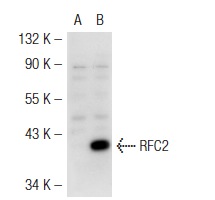
Western blot analysis of RFC2 expression in non-transfected: (A) and mouse RFC2 transfected: (B) 293T whole cell lysates.Application
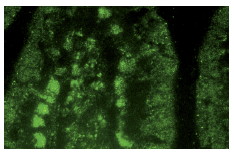
Immunofluorescence staining of normal mouse intestine frozen section showing nuclear staining.| Product Name | RFC2 Antibody (H-184) |
|---|---|
| Antibody Type | Primary Antibodies |
| Antigen Alias | epitope corresponding to amino acids 171-354 of RFC2 of human origin |
| Modification Notes | Replication factor C (RFC) is an essential DNA polymerase accessory protein that is required for numerous aspects of DNA metabolism including DNA replication, DNA repair, and telomere metabolism. RFC is a heteropentameric complex that recognizes a primer on a template DNA, binds to a primer terminus, and loads proliferating cell nuclear antigen (PCNA) onto DNA at primer-template junctions in an ATP-dependent reaction. All five of the RFC subunits share a set of related sequences (RFC boxes) that include nucleotide-binding consensus sequences. Four of the five RFC genes (RFC1, RFC2, RFC3, and RFC4) have consensus ATP-binding motifs. The small RFC proteins, RFC2, RFC3, RFC4 and RFC5, interact with Rad24, whereas the RFC1 subunit does not. RFC2, the third-largest subunit of the RFC complex, exhibits ATP binding which makes it important for both DNA replication and checkpoint function. The human RFC2 gene maps to chromosome 7q11.23 and encodes the RFC2 subunit. RFC2 has been associated with Williams-Beuren syndrome, which is a rare multi-system developmental disorder caused by the deletion of contiguous genes at 7q11.23. |
| Clonality | Polyclonal |
|---|---|
| Isotype | IgG |
| Host Species | Rabbit |
| Tested Applications | WBIPIFELISA |
| recommended for detection of RFC2 of mouse, rat and human origin by WB, IP, IF and ELISA also reactive with additional species, including equine, canine, bovine, porcine and avian: |
|
| Species Reactivity | HumanMouseRat |
| Concentration | 1mg/ml |
| Purification | Affinity purified |
| Alternative Names | epitope corresponding to amino acids 171-354 of RFC2 of human origin |
|---|---|
| Tissue Specificity | epitope corresponding to amino acids 171-354 of RFC2 of human origin |
| Entrez Gene | 5982 |
|---|
Application
Western blot analysis of RFC2 expression in non-transfected: (A) and mouse RFC2 transfected: (B) 293T whole cell lysates.
Application
Immunofluorescence staining of normal mouse intestine frozen section showing nuclear staining.| Application Notes | recommended for detection of RFC2 of mouse, rat and human origin by WB, IP, IF and ELISA also reactive with additional species, including equine, canine, bovine, porcine and avian: |
|---|
| Form | Liquid |
|---|---|
| Storage Instructions | For short-term storage, store at 4° C. For long-term storage, aliquot and store at -20ºC or below. Avoid multiple freeze-thaw cycles. |
| Storage Buffer | phosphate buffered saline , pH 7.4, 150mM NaCl, 0.02% sodium azide and 50% glycerol. |


