Application
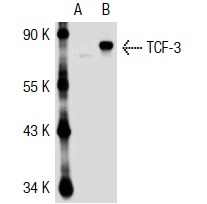
Western blot analysis of TCF-3 expression in non-transfected: (A) and human TCF-3 transfected: (B) 293T whole cell lysates.| Product Name | TCF-3 Antibody (M-155) |
|---|---|
| Antibody Type | Primary Antibodies |
| Antigen Alias | epitope corresponding to amino acids 421-575 mapping near the C-terminus of TCF-3 of mouse origin |
| Modification Notes | The TCF/LEF family of transcription factors are activated by the Wnt-1 and Wingless pathways and are characterized by the presence of a conserved protein motif, the high mobility group (HMG) 1 box, which mediates DNA binding. The TCF (T cell factor) proteins are required during developmental pathways. TCF-1 is essential for lymphoid cell development, while two other members, TCF-3 and TCF-4, are implicated in the development of the central nervous system. The Wnt mediated signaling pathway induces cytosolic ∫-catenin binding to TCF proteins within the nucleus, leading to the enhanced expression of the Wnt target genes. The ∫-catenin-TCF complexes are negatively regulated by the adenomatous polyposis coli (APC) tumor suppressor protein, which phosphorylates ∫-catenin and, in turn, increases the degradation of cytosolic ∫-catenin to, thereby, inhibit the activity of TCF proteins. Mutations in the APC gene, which are commonly observed in colorectal carcinomas, disrupt this regulatory pathway and correlate with an accumulation of ∫-catenin and the increased activation of the TCF target genes. |
| Clonality | Polyclonal |
|---|---|
| Isotype | IgG |
| Host Species | Rabbit |
| Tested Applications | WBIPIFELISAGSChIP |
| recommended for detection of TCF-3 of mouse, rat and human origin by WB, IP, IF and ELISA: |
|
| Species Reactivity | HumanMouseRat |
| Concentration | 1mg/ml |
| Purification | Affinity purified |
| Alternative Names | epitope corresponding to amino acids 421-575 mapping near the C-terminus of TCF-3 of mouse origin |
|---|---|
| Tissue Specificity | epitope corresponding to amino acids 421-575 mapping near the C-terminus of TCF-3 of mouse origin |
| Entrez Gene | 21415 |
|---|
Application
Western blot analysis of TCF-3 expression in non-transfected: (A) and human TCF-3 transfected: (B) 293T whole cell lysates.| Application Notes | recommended for detection of TCF-3 of mouse, rat and human origin by WB, IP, IF and ELISA: |
|---|
| Form | Liquid |
|---|---|
| Storage Instructions | For short-term storage, store at 4° C. For long-term storage, aliquot and store at -20ºC or below. Avoid multiple freeze-thaw cycles. |
| Storage Buffer | phosphate buffered saline , pH 7.4, 150mM NaCl, 0.02% sodium azide and 50% glycerol. |


