Application
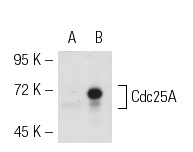
Western blot analysis of Cdc25A expression in non-transfected: (A) and mouse Cdc25A transfected: (B) 293T whole cell lysates.Application
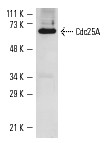
Western blot analysis of Cdc25A expression in WEHI-231 whole cell lysate.| Product Name | Cdc25A Antibody (M-191) |
|---|---|
| Antibody Type | Primary Antibodies |
| Antigen Alias | epitope corresponding to amino acids 323-514 mapping at the C-terminus of Cdc25A of mouse origin |
| Modification Notes | The Cdc2/cyclin B enzyme, involved in regulation of mitosis in eukaryotic cells, is subject to multiple levels of control. Among these, the regulation of the catalytic subunit by Tyrosine phosphorylation is the best understood. Tyrosine phosphorylation inhibits the Cdc2/cyclin B complex, while Tyrosine dephosphorylation, which occurs at the onset of mitosis, directly activates the pre-MPH complex. The Cdc25 gene serves as a rate-limiting mitotic activator, apparently due to its action as the Cdc2 Tyrosine phosphatase. In the absence of Cdc25, Cdc2 accumulates in a Tyrosine phosphorylated state. In addition, Cdc25 proteins from a variety of species have been shown to share a low degree of sequence similarity with other Tyrosine phosphatases. The Cdc25 gene family consists of at least three members that share approximately 40% identity in their most conserved carboxy-terminal sequences. |
| Clonality | Polyclonal |
|---|---|
| Isotype | IgG |
| Host Species | Rabbit |
| Tested Applications | WBIPIFELISA |
| recommended for detection of Cdc25A of mouse, rat and human origin by WB, IP, IF and ELISA also reactive with additional species, including equine, canine, bovine and porcine: |
|
| Species Reactivity | HumanMouseRat |
| Concentration | 1mg/ml |
| Purification | Affinity purified |
| Alternative Names | epitope corresponding to amino acids 323-514 mapping at the C-terminus of Cdc25A of mouse origin |
|---|---|
| Tissue Specificity | epitope corresponding to amino acids 323-514 mapping at the C-terminus of Cdc25A of mouse origin |
| Entrez Gene | 993 |
|---|
Application
Western blot analysis of Cdc25A expression in non-transfected: (A) and mouse Cdc25A transfected: (B) 293T whole cell lysates.
Application
Western blot analysis of Cdc25A expression in WEHI-231 whole cell lysate.| Application Notes | recommended for detection of Cdc25A of mouse, rat and human origin by WB, IP, IF and ELISA also reactive with additional species, including equine, canine, bovine and porcine: |
|---|
| Form | Liquid |
|---|---|
| Storage Instructions | For short-term storage, store at 4° C. For long-term storage, aliquot and store at -20ºC or below. Avoid multiple freeze-thaw cycles. |
| Storage Buffer | phosphate buffered saline , pH 7.4, 150mM NaCl, 0.02% sodium azide and 50% glycerol. |


