Application
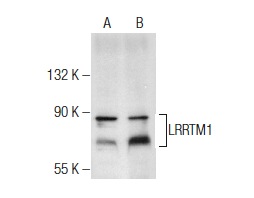
Western blot analysis of LRRTM1 expression in non-transfected: (A) and human LRRTM1 transfected: (B) 293T whole cell lysates.Application
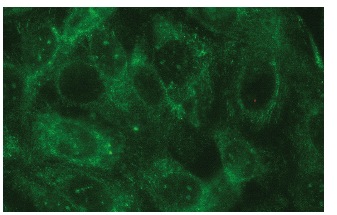
Immunofluorescence staining of methanol-fixed NIH/3T3 cells showing membrane localization.| Product Name | LRRTM1 Antibody (S-13) |
|---|---|
| Antibody Type | Primary Antibodies |
| Antigen Alias | epitope mapping within a C-terminal cytoplasmic domain of LRRTM1 of human origin |
| Modification Notes | The leucine-rich (LRR) repeat is a 20-30 amino acid motif that forms a hydrophobic å/∫ horseshoe fold, allowing it to accommodate several leucine residues within a tightly packed core. All LRR repeats contain a variable segment and a highly conserved segment, the latter of which accounts for 11 or 12 residues of the entire LRR motif. LRRTM1 (leucine rich repeat transmembrane neuronal 1) is a 522 amino acid single-pass type I membrane protein that localizes to the endoplasmic reticulum and contains ten LRR repeats. Expressed predominately in forebrain tissue, LRRTM1 is thought to be involved in the development of forebrain structures, specifically by influencing axon trafficking, as well as neuronal differentiation and connectivity. Human LRRTM1 shares 96% amino acid identity with its mouse counterpart, suggesting a conserved role between species. Defects in the gene encoding LRRTM1 may be associated with the pathogenesis of several common neurodevelopmental disorders. |
| Clonality | Polyclonal |
|---|---|
| Isotype | IgG |
| Host Species | Rabbit |
| Tested Applications | WBIPIFELISA |
| recommended for detection of LRRTM1 of mouse, rat and human origin by WB, IP, IF and ELISA non cross-reactive with other LRRTM family members also reactive with additional species, including avian: |
|
| Species Reactivity | HumanMouseRat |
| Concentration | 1mg/ml |
| Purification | Affinity purified |
| Alternative Names | epitope mapping within a C-terminal cytoplasmic domain of LRRTM1 of human origin |
|---|---|
| Tissue Specificity | epitope mapping within a C-terminal cytoplasmic domain of LRRTM1 of human origin |
| Entrez Gene | 347730 |
|---|
Application
Western blot analysis of LRRTM1 expression in non-transfected: (A) and human LRRTM1 transfected: (B) 293T whole cell lysates.
Application
Immunofluorescence staining of methanol-fixed NIH/3T3 cells showing membrane localization.| Application Notes | recommended for detection of LRRTM1 of mouse, rat and human origin by WB, IP, IF and ELISA non cross-reactive with other LRRTM family members also reactive with additional species, including avian: |
|---|
| Form | Liquid |
|---|---|
| Storage Instructions | For short-term storage, store at 4° C. For long-term storage, aliquot and store at -20ºC or below. Avoid multiple freeze-thaw cycles. |
| Storage Buffer | phosphate buffered saline , pH 7.4, 150mM NaCl, 0.02% sodium azide and 50% glycerol. |


