Application
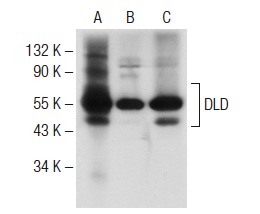
Western blot analysis of DLD expression in mouse heart tissue extract (A) and HeLa (B) and OV-90 (C) whole cell lysates.| Product Name | DLD Antibody (H-154) |
|---|---|
| Antibody Type | Primary Antibodies |
| Antigen Alias | epitope corresponding to amino acids 356-509 mapping at the C-terminus of DLD of human origin |
| Modification Notes | DLD (Dihydrolipoyl dehyrogenase or Dihydrolipoamide dehydrogenase), also known as GCSL (glycine cleavage system L protein), PHE3, DLDH or LAD, is a member of the class I pyridine nucleotide-disulfide oxidoreductase family. DLD is a flavin-dependent oxidoreductase and functions as a component of the å-keto acid dehydrogenase, the pyruvate dehydrogenase, the å-ketoglutarate dehydrogenase, the branched-chain å-keto acid dehydrogenase and as the L protein in the mitochondrial glycine cleavage system. DLD localizes to the mitochondrial matrix and exists as a monomer, homodimer or tetramer that is required for energy metabolism in all eukaryotes. More specifically, DLD generates NADH and lipoic acid from dihydrolipoic acid and NAD+. The DLD homodimer catalyzes the opposite reaction. Mutations in the gene encoding DLD can result in MSUD (maple syrup urine disease) and congenital infantile lactic acidosis. |
| Clonality | Polyclonal |
|---|---|
| Isotype | IgG |
| Host Species | Rabbit |
| Tested Applications | WBIPIFELISA |
| recommended for detection of DLD of mouse, rat and human origin by WB, IP, IF and ELISA also reactive with additional species, including equine, canine, bovine, porcine and avian: |
|
| Species Reactivity | HumanMouseRat |
| Concentration | 1mg/ml |
| Purification | Affinity purified |
| Alternative Names | epitope corresponding to amino acids 356-509 mapping at the C-terminus of DLD of human origin |
|---|---|
| Tissue Specificity | epitope corresponding to amino acids 356-509 mapping at the C-terminus of DLD of human origin |
| Entrez Gene | 1738 |
|---|
Application
Western blot analysis of DLD expression in mouse heart tissue extract (A) and HeLa (B) and OV-90 (C) whole cell lysates.| Application Notes | recommended for detection of DLD of mouse, rat and human origin by WB, IP, IF and ELISA also reactive with additional species, including equine, canine, bovine, porcine and avian: |
|---|
| Form | Liquid |
|---|---|
| Storage Instructions | For short-term storage, store at 4° C. For long-term storage, aliquot and store at -20ºC or below. Avoid multiple freeze-thaw cycles. |
| Storage Buffer | phosphate buffered saline , pH 7.4, 150mM NaCl, 0.02% sodium azide and 50% glycerol. |


