Application
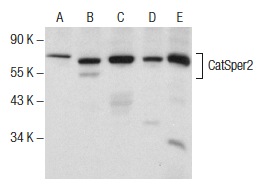
Western blot analysis of CatSper2 expression in 293T (A), Hep G2 (B), MCF7 (C) and Y79 (D) whole cell lysates and mouse testis tissue extract (E).| Product Name | CatSper2 Antibody (H-60) |
|---|---|
| Antibody Type | Primary Antibodies |
| Antigen Alias | epitope corresponding to amino acids 471-530 mapping at the C-terminus of CatSper2 of human origin |
| Modification Notes | CatSpers (cation channel, sperm associated proteins) are ion transport proteins located on the surface of sperm cells in the principal piece of the sperm tail. CatSpers are vital to sperm motility, fertilization and cAMP-mediated calcium influx in sperm. There are four CatSper proteins in mammalian sperm, namely CatSper (or CatSper1), CatSper2, CatSper3 and CatSper4. CatSper proteins contain a single, six-transmembrane-spanning segment and exhibit the voltage-dependent Ca2+ channel four-repeat structure. CatSper proteins are believed to assemble into a heterotetrameric complex, forming an alkalinization-activated Ca2+-selective channel. Mutations in any of the genes encoding CatSper family proteins can result in male infertility. CatSper2 plays an important role in the hyperactivated motility of sperm cells, a process that is required in the preparation of sperm for fertilization. |
| Clonality | Polyclonal |
|---|---|
| Isotype | IgG |
| Host Species | Rabbit |
| Tested Applications | WBIPIFELISA |
| recommended for detection of CatSper2 of mouse, rat and human origin by WB, IP, IF and ELISA also reactive with additional species, including equine, canine, bovine and porcine: |
|
| Species Reactivity | HumanMouseRat |
| Concentration | 1mg/ml |
| Purification | Affinity purified |
| Alternative Names | epitope corresponding to amino acids 471-530 mapping at the C-terminus of CatSper2 of human origin |
|---|---|
| Tissue Specificity | epitope corresponding to amino acids 471-530 mapping at the C-terminus of CatSper2 of human origin |
| Entrez Gene | 117155 |
|---|
Application
Western blot analysis of CatSper2 expression in 293T (A), Hep G2 (B), MCF7 (C) and Y79 (D) whole cell lysates and mouse testis tissue extract (E).| Application Notes | recommended for detection of CatSper2 of mouse, rat and human origin by WB, IP, IF and ELISA also reactive with additional species, including equine, canine, bovine and porcine: |
|---|
| Form | Liquid |
|---|---|
| Storage Instructions | For short-term storage, store at 4° C. For long-term storage, aliquot and store at -20ºC or below. Avoid multiple freeze-thaw cycles. |
| Storage Buffer | phosphate buffered saline , pH 7.4, 150mM NaCl, 0.02% sodium azide and 50% glycerol. |


