Application
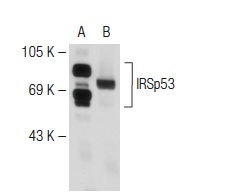
Western blot analysis of IRSp53 expression in mouse brain (A) and mouse testis (B) tissue extracts.| Product Name | IRSp53 Antibody (H-99) |
|---|---|
| Antibody Type | Primary Antibodies |
| Antigen Alias | epitope corresponding to amino acids 42-140 mapping near the N-terminus of IRSp53 of human origin |
| Modification Notes | The scaffolding protein insulin receptor tyrosine kinase substrate p53 (IRSp53), a ubiquitous regulator of the Actin cytoskeleton, mediates filopodia formation under the control of Rho-family GTPases. It is expressed in the cytoplasm and links small membrane-bound G-proteins to cytoplasmic effector proteins. IRSp53 comprises a central SH3 domain, which binds to proline-rich regions of a wide range of Actin regulators, and a conserved N-terminal IRSp53/MIM homology domain (IMD) that harbors F-Actin-bundling activity. IRSp53 inter-acts with atrophin-1, the product of the dentatorubral-pallidoluysian atrophy (DRPLA) gene, which is associated with an autosomal dominant neurodegenerative disease. The IRSp53 protein also interacts with ENAH, BAI-1, Eps8, Shank 1, Shank 2, Shank 3, WAVE1, WAVE2, Tiam1 and Dia 1. |
| Clonality | Polyclonal |
|---|---|
| Isotype | IgG |
| Host Species | Rabbit |
| Tested Applications | WBIPIFELISA |
| recommended for detection of IRSp53 of mouse, rat and human origin by WB, IP, IF and ELISA also reactive with additional species, including equine, canine, bovine, porcine and avian: |
|
| Species Reactivity | HumanMouseRat |
| Concentration | 1mg/ml |
| Purification | Affinity purified |
| Alternative Names | epitope corresponding to amino acids 42-140 mapping near the N-terminus of IRSp53 of human origin |
|---|---|
| Tissue Specificity | epitope corresponding to amino acids 42-140 mapping near the N-terminus of IRSp53 of human origin |
| Entrez Gene | 10458 |
|---|
Application
Western blot analysis of IRSp53 expression in mouse brain (A) and mouse testis (B) tissue extracts.| Application Notes | recommended for detection of IRSp53 of mouse, rat and human origin by WB, IP, IF and ELISA also reactive with additional species, including equine, canine, bovine, porcine and avian: |
|---|
| Form | Liquid |
|---|---|
| Storage Instructions | For short-term storage, store at 4° C. For long-term storage, aliquot and store at -20ºC or below. Avoid multiple freeze-thaw cycles. |
| Storage Buffer | phosphate buffered saline , pH 7.4, 150mM NaCl, 0.02% sodium azide and 50% glycerol. |


