Application
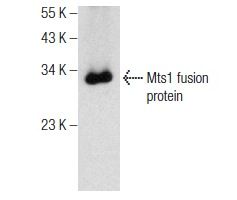
Western blot analysis of human recombinant Mts1 fusion protein.| Product Name | Mts1 Antibody (H-58) |
|---|---|
| Antibody Type | Primary Antibodies |
| Antigen Alias | epitope corresponding to amino acids 44-101 mapping at the C-terminus of Mts1 of human origin |
| Modification Notes | The Mts1 gene encodes a small acidic Ca2+-binding protein, Mts1 (also designated S100A4, calvasculin or metastasin). Mts1 belongs to the S100 family of small Ca2+-binding proteins and is expressed in a cell-specific manner. Mts1 protein is involved in tumor progression and metastasis, and also has a significant stimulatory effect on angiogenesis. The level of Mts1 protein in serum increases with aging, suggesting that Mts1 may play a role in the ind-uction of tumor progression via stimulation of angiogenesis. In addition, Mts1 cooperates with p53 in apoptosis induction by binding to the C-term-inal regulatory domain of p53 to inhibit the DNA binding activity of p53. The ability of Mts1 to enhance p53-dependent apoptosis may accelerate the loss of p53 function in tumors. Thus, Mts1 can contribute to the development of a more aggressive phenotype during tumor progression. |
| Clonality | Polyclonal |
|---|---|
| Isotype | IgG |
| Host Species | Rabbit |
| Tested Applications | WBIPIFELISA |
| recommended for detection of Mts1 of mouse, rat and human origin by WB, IP, IF and ELISA also reactive with additional species, including equine, canine, bovine and porcine: |
|
| Species Reactivity | HumanMouseRat |
| Concentration | 1mg/ml |
| Purification | Affinity purified |
| Alternative Names | epitope corresponding to amino acids 44-101 mapping at the C-terminus of Mts1 of human origin |
|---|---|
| Tissue Specificity | epitope corresponding to amino acids 44-101 mapping at the C-terminus of Mts1 of human origin |
| Entrez Gene | 6275 |
|---|
Application
Western blot analysis of human recombinant Mts1 fusion protein.| Application Notes | recommended for detection of Mts1 of mouse, rat and human origin by WB, IP, IF and ELISA also reactive with additional species, including equine, canine, bovine and porcine: |
|---|
| Form | Liquid |
|---|---|
| Storage Instructions | For short-term storage, store at 4° C. For long-term storage, aliquot and store at -20ºC or below. Avoid multiple freeze-thaw cycles. |
| Storage Buffer | phosphate buffered saline , pH 7.4, 150mM NaCl, 0.02% sodium azide and 50% glycerol. |


