Application
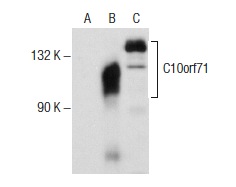
Western blot analysis of C10orf71 expression in non-transfected 293T: (A), human C10orf71 transfected 293T: (B) and HuT 78 (C) whole cell lysates.Application
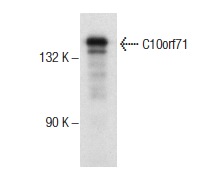
Western blot analysis of C10orf71 expression in MCF7 whole cell lysate.| Product Name | C10orf71 Antibody (S-17) |
|---|---|
| Antibody Type | Primary Antibodies |
| Antigen Alias | epitope mapping near the N-terminus of C10orf71 of human origin |
| Modification Notes | C10orf71 (chromosome 10 open reading frame 71) is a 1,435 amino acid protein that exists as two alternatively spliced isoforms that are encoded by a gene located on human chromosome 10. Spanning nearly 135 million base pairs, chromosome 10 makes up approximately 4.5% of total DNA in cells and encodes nearly 1,200 genes. Several protein-coding genes, including those that encode for chemokines, cadherins, excision repair proteins, early growth response factors (Egrs) and fibroblast growth receptors (FGFRs), are located on chromosome 10. Defects in some of the genes that map to chromosome 10 are associated with Charcot-Marie Tooth disease, Jackson-Weiss syndrome, Usher syndrome, nonsyndromatic deafness, Wolman’s syndrome, Cowden syndrome, multiple endocrine neoplasia type 2 and porphyria. |
| Clonality | Polyclonal |
|---|---|
| Isotype | IgG |
| Host Species | Rabbit |
| Tested Applications | WBIPIFELISA |
| recommended for detection of C10orf71 of human origin, 3425401B19Rik of mouse origin and the corresponding rat homolog by WB, IP, IF and ELISA also reactive with additional species, including canine, bovine and porcine: |
|
| Species Reactivity | HumanMouseRat |
| Concentration | 1mg/ml |
| Purification | Affinity purified |
| Alternative Names | epitope mapping near the N-terminus of C10orf71 of human origin |
|---|---|
| Tissue Specificity | epitope mapping near the N-terminus of C10orf71 of human origin |
| Entrez Gene | 118461 |
|---|
Application
Western blot analysis of C10orf71 expression in non-transfected 293T: (A), human C10orf71 transfected 293T: (B) and HuT 78 (C) whole cell lysates.
Application
Western blot analysis of C10orf71 expression in MCF7 whole cell lysate.| Application Notes | recommended for detection of C10orf71 of human origin, 3425401B19Rik of mouse origin and the corresponding rat homolog by WB, IP, IF and ELISA also reactive with additional species, including canine, bovine and porcine: |
|---|
| Form | Liquid |
|---|---|
| Storage Instructions | For short-term storage, store at 4° C. For long-term storage, aliquot and store at -20ºC or below. Avoid multiple freeze-thaw cycles. |
| Storage Buffer | phosphate buffered saline , pH 7.4, 150mM NaCl, 0.02% sodium azide and 50% glycerol. |


