Application
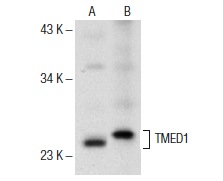
Western blot analysis of TMED1 expression in human stomach (A) and mouse liver (B) tissue extracts.| Product Name | TMED1 Antibody (H-53) |
|---|---|
| Antibody Type | Primary Antibodies |
| Antigen Alias | epitope corresponding to amino acids 123-175 mapping within an internal region of TMED1 of human origin |
| Modification Notes | TMED1 (transmembrane emp24 protein transport domain containing 1), also known as ST2L, Il1rl1l or IL1RL1LG, is a 227 amino acid member of the EMP24/GP25L family. Widely expressed, TMED1 is a single-pass type I membrane protein containing one GOLD domain. Associated with membrane proteins, the GOLD (golgi dynamics) domain is a region of about 90 to 150 amino acids that mediates protein-protein interactions. The GOLD domain interacts with lipid, sterol or fatty acid-domains as well as with the RUN domain, which interacts with cytoskeletal filaments, of membrane proteins. Suggested to play a role in protein trafficking, TMED1 is encoded by a gene located on human chromosome 19, which consists of over 63 million bases, houses approximately 1,400 genes and is recognized for having the greatest gene density of the human chromosomes. |
| Clonality | Polyclonal |
|---|---|
| Isotype | IgG |
| Host Species | Rabbit |
| Tested Applications | WBIPIFELISA |
| recommended for detection of TMED1 of mouse, rat and human origin by WB, IP, IF and ELISA also reactive with additional species, including equine, canine, bovine and porcine: |
|
| Species Reactivity | HumanMouseRat |
| Concentration | 1mg/ml |
| Purification | Affinity purified |
| Alternative Names | epitope corresponding to amino acids 123-175 mapping within an internal region of TMED1 of human origin |
|---|---|
| Tissue Specificity | epitope corresponding to amino acids 123-175 mapping within an internal region of TMED1 of human origin |
| Entrez Gene | 11018 |
|---|
Application
Western blot analysis of TMED1 expression in human stomach (A) and mouse liver (B) tissue extracts.| Application Notes | recommended for detection of TMED1 of mouse, rat and human origin by WB, IP, IF and ELISA also reactive with additional species, including equine, canine, bovine and porcine: |
|---|
| Form | Liquid |
|---|---|
| Storage Instructions | For short-term storage, store at 4° C. For long-term storage, aliquot and store at -20ºC or below. Avoid multiple freeze-thaw cycles. |
| Storage Buffer | phosphate buffered saline , pH 7.4, 150mM NaCl, 0.02% sodium azide and 50% glycerol. |


