Application
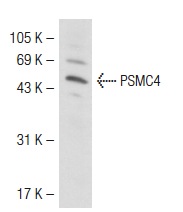
Western blot analysis of PSMC4 expression in HEL 92.1.7 whole cell lysate.| Product Name | PSMC4 Antibody (H-167) |
|---|---|
| Antibody Type | Primary Antibodies |
| Antigen Alias | epitope corresponding to amino acids 1-167 mapping at the N-terminus of PSMC4 of human origin |
| Modification Notes | In eukaryotic cells, selective breakdown of cellular proteins is ensured by their ubiquitination and subsequent degradation by the 26S proteasome. At specific stages of development, embryo- and tissue-specific components of the 26S proteasome are formed, which are responsible for proteolysis. These components of the 26S proteasome include Rpn10a through Rpn10e, or, alternatively, pUb-R2 through pUb-R5, and can be generated by a single Rpn10 gene by developmentally regulated alternative splicing. Gankyrin and p44S10 are proteasome regulatory particles that are expressed in heart, liver, skeletal muscle and pancreas. Proteasome component C2 (PROS-30), also designated Macropain subunit C2, is a prosomal protein involved in a non-lysosomal atp/ubiquitin-dependent proteolytic pathway. PSMC4 (26S protease regulatory subunit 6B) is involved in the ATP-dependent degradation of ubiquitinated proteins. PSMC4 interacts with with gankyrin, a liver oncoprotein as well as with a liver-specific member of the nuclear hormone receptor superfamily. |
| Clonality | Polyclonal |
|---|---|
| Isotype | IgG |
| Host Species | Rabbit |
| Tested Applications | WBIPIFELISA |
| recommended for detection of PSMC4 of mouse, rat and human origin by WB, IP, IF and ELISA also reactive with additional species, including equine, canine, bovine and porcine: |
|
| Species Reactivity | HumanMouseRat |
| Concentration | 1mg/ml |
| Purification | Affinity purified |
| Alternative Names | epitope corresponding to amino acids 1-167 mapping at the N-terminus of PSMC4 of human origin |
|---|---|
| Tissue Specificity | epitope corresponding to amino acids 1-167 mapping at the N-terminus of PSMC4 of human origin |
| Entrez Gene | 5704 |
|---|
Application
Western blot analysis of PSMC4 expression in HEL 92.1.7 whole cell lysate.| Application Notes | recommended for detection of PSMC4 of mouse, rat and human origin by WB, IP, IF and ELISA also reactive with additional species, including equine, canine, bovine and porcine: |
|---|
| Form | Liquid |
|---|---|
| Storage Instructions | For short-term storage, store at 4° C. For long-term storage, aliquot and store at -20ºC or below. Avoid multiple freeze-thaw cycles. |
| Storage Buffer | phosphate buffered saline , pH 7.4, 150mM NaCl, 0.02% sodium azide and 50% glycerol. |


