Application
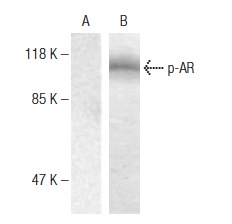
Blots were probed with p-AR (Ser 210): preincubated with cognate phosphorylated peptide (A) and p-AR (Ser 210): (B).| Product Name | p-AR Antibody (Ser 213) |
|---|---|
| Antibody Type | Primary Antibodies |
| Antigen Alias | recommended for detection of Ser 213 phosphorylated Androgen Receptor of human origin by WB and IP |
| Modification | Phosphoralated |
| Modification Notes | Androgens exhibit a wide range of effects on the development, maintenance and regulation of male phenotype and reproductive physiology in males (1). The androgen receptor (AR) is a member of the steroid superfamily of ligand-dependent transcription factors. ARs bind active testosterone (T) and dihydrotestosterone (DHT) (2,3). The rates of association and dissociation of T are about 3 times more rapid than those of DHT (4,5). This difference in binding kinetics may account for the different physiological effects of T and DHT (6). Androgen binding results in an at least 6-fold increase in androgen receptor stability (6,7). Akt phosphorylates human AR at serine residues 210 and 790 (8). The synthetic androgen R1881 elevates phosphorylation of serine residues 308 and 650 in vitro (9). |
| Clonality | Polyclonal |
|---|---|
| Isotype | IgG |
| Host Species | Rabbit |
| Tested Applications | WBIP |
| WB:1:500~1:2000 IP:1:100~1:500 Notes:Optimal dilutions/concentrations should be determined by the researcher. |
|
| Species Reactivity | HumanMouseRat |
| Concentration | 1mg/ml |
| Purification | Affinity purified |
| Alternative Names | recommended for detection of Ser 213 phosphorylated Androgen Receptor of human origin by WB and IP |
|---|---|
| Tissue Specificity | recommended for detection of Ser 213 phosphorylated Androgen Receptor of human origin by WB and IP |
| Entrez Gene | 367 |
|---|
Application
Blots were probed with p-AR (Ser 210): preincubated with cognate phosphorylated peptide (A) and p-AR (Ser 210): (B).| Application Notes | WB:1:500~1:2000 IP:1:100~1:500 Notes:Optimal dilutions/concentrations should be determined by the researcher. |
|---|
| Form | Liquid |
|---|---|
| Storage Instructions | For short-term storage, store at 4° C. For long-term storage, aliquot and store at -20ºC or below. Avoid multiple freeze-thaw cycles. |
| Storage Buffer | phosphate buffered saline , pH 7.4, 150mM NaCl, 0.02% sodium azide and 50% glycerol. |


