Application
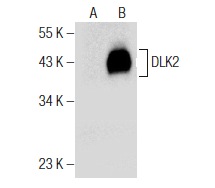
Western blot analysis of DLK2 expression in non-transfected: (A) and human DLK2 transfected: (B) 293T whole cell lysates.| Product Name | DLK2 Antibody (H-125) |
|---|---|
| Antibody Type | Primary Antibodies |
| Antigen Alias | epitope corresponding to amino acids 181-305 mapping within an N-terminal extracellular domain of DLK2 of human origin |
| Modification Notes | DLK2 (delta homolog 2), also known as EGFL9 (Epidermal growth factor-like protein 9), is a 383 amino acid single-pass transmembrane protein with six tandem EGF-like repeats in the putative extracellular domain, which is characteristic of the EGF-like protein family. DLK2 shares nearly identical structural features with DLK, suggesting that it may function in a similar way. Like DLK, DLK2 affects adipogenesis of 3T3-L1 preadipocytes and mesenchymal C3H10T1/2 cells, yet it does so in an opposite way to that of DLK. Also, expression of DLK and DLK2 are inversely correlated and changes in expression of one gene will affect the expression levels of the other. Therefore, it is likely that adipogenesis is modulated by the coordinated expression of DLK and DLK2. There are two isoforms of DLK2 that are produced as a result of alternative splicing events. |
| Clonality | Polyclonal |
|---|---|
| Isotype | IgG |
| Host Species | Rabbit |
| Tested Applications | WBIPIFELISA |
| recommended for detection of DLK2 of mouse, rat and human origin by WB, IP, IF and ELISA also reactive with additional species, including equine, bovine and porcine: |
|
| Species Reactivity | HumanMouseRat |
| Concentration | 1mg/ml |
| Purification | Affinity purified |
| Alternative Names | epitope corresponding to amino acids 181-305 mapping within an N-terminal extracellular domain of DLK2 of human origin |
|---|---|
| Tissue Specificity | epitope corresponding to amino acids 181-305 mapping within an N-terminal extracellular domain of DLK2 of human origin |
Application
Western blot analysis of DLK2 expression in non-transfected: (A) and human DLK2 transfected: (B) 293T whole cell lysates.| Application Notes | recommended for detection of DLK2 of mouse, rat and human origin by WB, IP, IF and ELISA also reactive with additional species, including equine, bovine and porcine: |
|---|
| Form | Liquid |
|---|---|
| Storage Instructions | For short-term storage, store at 4° C. For long-term storage, aliquot and store at -20ºC or below. Avoid multiple freeze-thaw cycles. |
| Storage Buffer | phosphate buffered saline , pH 7.4, 150mM NaCl, 0.02% sodium azide and 50% glycerol. |


