Application
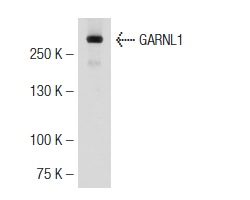
Western blot analysis of GARNL1 expression in WI 38 whole cell lysate.| Product Name | GARNL1 Antibody (H-221) |
|---|---|
| Antibody Type | Primary Antibodies |
| Antigen Alias | epitope corresponding to amino acids 263-443 mapping near the N-terminus of GARNL1 of human origin |
| Modification Notes | GARNL1 (GTPase activating Rap/Ran-GAP domain-like 1), also known as TULIP1 (Tuberin-like protein1) or GRIPE (GAP-related-interacting partner to E12), contains one Rap-GAP domain. It is expressed during embryogenesis with E12. During development, GARNL1 expression decreases, persisting at high levels only in neurons of the adult brain. GARNL1 localizes to the cytoplasm where it may play a role regulating GTP hydrolysis of proteins such as Ran and Rap. GARNL1 is imported to the nucleus via dimerization with E12. GARNL1 interacts with the HLH region of E12 and may function to negatively regulate the transcription of E12-dependent downstream target genes. This suggests that at least a portion of the function of GARNL1 is dependent upon its association with E12. GARNL1 may also associate with other HLH proteins and influence a variety of HLH signaling cascades. In adult brain, GARNL1 activity does not involve E12 and therefore it may serve a different function in developed neural tissue. |
| Clonality | Polyclonal |
|---|---|
| Isotype | IgG |
| Host Species | Rabbit |
| Tested Applications | WBIPIFELISA |
| recommended for detection of GARNL1 of mouse, rat and human origin by WB, IP, IF and ELISA also reactive with additional species, including canine, porcine and avian: |
|
| Species Reactivity | HumanMouseRat |
| Concentration | 1mg/ml |
| Purification | Affinity purified |
| Alternative Names | epitope corresponding to amino acids 263-443 mapping near the N-terminus of GARNL1 of human origin |
|---|---|
| Tissue Specificity | epitope corresponding to amino acids 263-443 mapping near the N-terminus of GARNL1 of human origin |
| Entrez Gene | 253959 |
|---|
Application
Western blot analysis of GARNL1 expression in WI 38 whole cell lysate.| Application Notes | recommended for detection of GARNL1 of mouse, rat and human origin by WB, IP, IF and ELISA also reactive with additional species, including canine, porcine and avian: |
|---|
| Form | Liquid |
|---|---|
| Storage Instructions | For short-term storage, store at 4° C. For long-term storage, aliquot and store at -20ºC or below. Avoid multiple freeze-thaw cycles. |
| Storage Buffer | phosphate buffered saline , pH 7.4, 150mM NaCl, 0.02% sodium azide and 50% glycerol. |


