Application
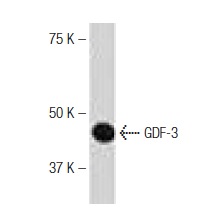
Western blot analysis of GDF-3 expression in mouse kidney tissue extract.Application
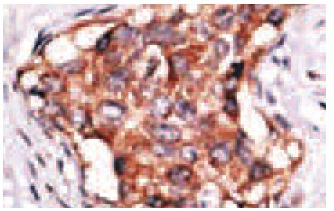
Immunoperoxidase staining of formalin-fixed, paraffin-embedded human breast carcinoma tissue showing cytoplasmic and membrane localization.| Product Name | GDF-3 Antibody (W-25) |
|---|---|
| Antibody Type | Primary Antibodies |
| Antigen Alias | recommended for detection of GDF-3 of mouse and human origin by WB, IP, IF, IHC(P) and ELISA |
| Modification Notes | Growth/differentiation factors (GDFs) are members of the TGF superfamily. Members of the TGF superfamily are involved in embryonic development and adult tissue homeostasis. GDF-1 expression is almost exclusively restricted to the central nervous system and mediates cell differentiation events during embryonic development. Neither GDF-3 (Vgr-2) nor GDF-9 contains the conserved cysteine residue which is found in most other TGF superfamily members. GDF-3 is detectable in bone marrow, spleen, thymus and adipose tissue, whereas GDF-9 has only been detected in ovary. GDF-5 (also designated CDMP-1) has been shown to induce activation of plasminogen activator, thereby inducing angiogenesis. It is predominantly expressed in long bones during fetal embryonic development and is involved in bone formation. GDF-5 mutations have been identified in mice with the mutation brachypodism (bp), a mutation which affects the length and number of bones in limbs. GDF-6 and GDF-7 are closely related to GDF-5. GDF-8 has been shown to be a negative regulator of skeletal muscle mass. |
| Clonality | Polyclonal |
|---|---|
| Isotype | IgG |
| Host Species | Rabbit |
| Tested Applications | WBIPIFIHCELISA |
| WB:1:500~1:2000 IP:1:100~1:500 IF:1:200~1:500 IHC:1:50~1:200 Notes:Optimal dilutions/concentrations should be determined by the researcher. |
|
| Species Reactivity | HumanMouseRat |
| Concentration | 1mg/ml |
| Purification | Affinity purified |
| Alternative Names | recommended for detection of GDF-3 of mouse and human origin by WB IP IF IHC(P) and ELISA |
|---|---|
| Tissue Specificity | recommended for detection of GDF-3 of mouse and human origin by WB, IP, IF, IHC(P) and ELISA |
| Entrez Gene | 9573 |
|---|
Application
Western blot analysis of GDF-3 expression in mouse kidney tissue extract.
Application
Immunoperoxidase staining of formalin-fixed, paraffin-embedded human breast carcinoma tissue showing cytoplasmic and membrane localization.| Application Notes | WB:1:500~1:2000 IP:1:100~1:500 IF:1:200~1:500 IHC:1:50~1:200 Notes:Optimal dilutions/concentrations should be determined by the researcher. |
|---|
| Form | Liquid |
|---|---|
| Storage Instructions | For short-term storage, store at 4° C. For long-term storage, aliquot and store at -20ºC or below. Avoid multiple freeze-thaw cycles. |
| Storage Buffer | phosphate buffered saline , pH 7.4, 150mM NaCl, 0.02% sodium azide and 50% glycerol. |


