Application
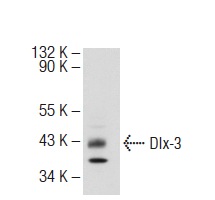
Western blot analysis of Dlx-3 expression in JEG-3 whole cell lysate.| Product Name | Dlx-3 Antibody (H-80) |
|---|---|
| Antibody Type | Primary Antibodies |
| Antigen Alias | epitope corresponding to amino acids 208-287 mapping at the C-terminus of Dlx-3 of human origin |
| Modification Notes | Dlx genes are a highly conserved family of six different (Dlx1–6) homeo box-containing genes that share homology with distal-less (Dll), a gene expressed in the head and limbs of the developing fruit fly. Dlx genes are expressed in spatially and temporally restricted patterns in craniofacial primordia, basal telencephalon and diencephalon, and in distal regions of extending appendages, including the limb and the genital bud. The differential expression of Dlx influences patterning, morphogenesis and histogenesis in these tissues. The Dlx gene products can activate transcription and are localized primarily to the nucleus, although Dlx-5 can be found in the cytoplasm. Dlx proteins influence different stages of proper tissue development, including patterning of the orofacial skeleton (craniofacial ectomesenchyme) and differentiation of structures within and between teeth. |
| Clonality | Polyclonal |
|---|---|
| Isotype | IgG |
| Host Species | Rabbit |
| Tested Applications | WBIPIFELISA |
| recommended for detection of Dlx-3 of mouse, rat and human origin by WB, IP, IF and ELISA also reactive with additional species, including equine, canine, bovine and porcine: |
|
| Species Reactivity | HumanMouseRat |
| Concentration | 1mg/ml |
| Purification | Affinity purified |
| Alternative Names | epitope corresponding to amino acids 208-287 mapping at the C-terminus of Dlx-3 of human origin |
|---|---|
| Tissue Specificity | epitope corresponding to amino acids 208-287 mapping at the C-terminus of Dlx-3 of human origin |
| Entrez Gene | 1747 |
|---|
Application
Western blot analysis of Dlx-3 expression in JEG-3 whole cell lysate.| Application Notes | recommended for detection of Dlx-3 of mouse, rat and human origin by WB, IP, IF and ELISA also reactive with additional species, including equine, canine, bovine and porcine: |
|---|
| Form | Liquid |
|---|---|
| Storage Instructions | For short-term storage, store at 4° C. For long-term storage, aliquot and store at -20ºC or below. Avoid multiple freeze-thaw cycles. |
| Storage Buffer | phosphate buffered saline , pH 7.4, 150mM NaCl, 0.02% sodium azide and 50% glycerol. |


