Application
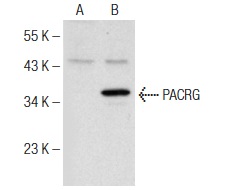
Western blot analysis of PACRG expression in non-transfected (A) and human PACRG transfected (B) whole cell lysates.| Product Name | PACRG Antibody (H-100) |
|---|---|
| Antibody Type | Primary Antibodies |
| Antigen Alias | epitope corresponding to amino acids 1-100 mapping near the N-terminus of PACRG of human origin |
| Modification Notes | The deduced 257 amino acid protein PACRG (Parkin co-regulated gene) shows potential links to the ubiquitin/proteasome system. PACRG and Parkin are attached in a head-to-head arrangement on opposite DNA strands and share a common 5' flanking promoter region. The PACRG gene maps to chromosome 6q26; Northern blot analysis detects PACRG expression in all tissues examined except placenta. Using a positional cloning strategy in 197 Vietnamese leprosy simplex families (i.e. families with two unaffected parents and one affected child), significant connections between leprosy and 17 markers in the 5' regulatory region that PARK2 and PACRG share were observed. Possession of two or more of the 17 risk alleles is highly predictive of leprosy. |
| Clonality | Polyclonal |
|---|---|
| Isotype | IgG |
| Host Species | Rabbit |
| Tested Applications | WBIPIFELISA |
| recommended for detection of PACRG of mouse, rat and human origin by WB, IP, IF and ELISA also reactive with additional species, including equine, canine and bovine: |
|
| Species Reactivity | HumanMouseRat |
| Concentration | 1mg/ml |
| Purification | Affinity purified |
| Alternative Names | epitope corresponding to amino acids 1-100 mapping near the N-terminus of PACRG of human origin |
|---|---|
| Tissue Specificity | epitope corresponding to amino acids 1-100 mapping near the N-terminus of PACRG of human origin |
| Entrez Gene | 135138 |
|---|
Application
Western blot analysis of PACRG expression in non-transfected (A) and human PACRG transfected (B) whole cell lysates.| Application Notes | recommended for detection of PACRG of mouse, rat and human origin by WB, IP, IF and ELISA also reactive with additional species, including equine, canine and bovine: |
|---|
| Form | Liquid |
|---|---|
| Storage Instructions | For short-term storage, store at 4° C. For long-term storage, aliquot and store at -20ºC or below. Avoid multiple freeze-thaw cycles. |
| Storage Buffer | phosphate buffered saline , pH 7.4, 150mM NaCl, 0.02% sodium azide and 50% glycerol. |


