Application
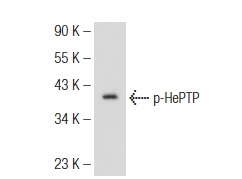
Western blot analysis of HePTP phosphorylation in Jurkat whole cell lysate.| Product Name | p-HePTP Antibody (Ser 93) |
|---|---|
| Antibody Type | Primary Antibodies |
| Antigen Alias | recommended for detection of Ser 93 phosphorylated HePTP of human origin by WB, IP and ELISA |
| Modification | Phosphoralated |
| Modification Notes | Hematopoietic protein tyrosine phosphatase (HePTP) belongs to a subgroup of PTPases with two other members, STEP and PCPTP1, all of which consist of a single C-terminal PTPase domain that is preceded by a noncatalytic N-terminal domain. Unlike STEP and PCPTP1, which are expressed primarily in the central nervous system, HePTP is expressed in thymus, spleen and in leukemic cell lines, including Jurkat T leukemia cells. The gene encoding HePTP was originally cloned from human T lymphocytes, and it maps to chromosome 1q32.1, a site frequently mutated in preleukemic myeloproliferative disease. The locus of the gene suggests a role for HePTP in cell proliferation and differentiation. The HePTP gene is transcriptionally activated in T cells treated with Interleukin 6. HePTP mRNA levels increase several-fold in normal mouse lymphocytes upon stimulation with phytohemagglutinin, lipopolysaccharide, concanavalin A and anti-CD3. Overexpression of HePTP reduces T cell receptor (TCR)-induced activation of ERK 2, and interferes with PMA and growth factor-induced MAPK activation in myeloid cells. In resting T-cells, HePTP may be phosphorylated on serine residues, such as Ser 93 in human HePTP. |
| Clonality | Polyclonal |
|---|---|
| Isotype | IgG |
| Host Species | Rabbit |
| Tested Applications | WBIPELISA |
| WB:1:500~1:2000 IP:1:100~1:500 Notes:Optimal dilutions/concentrations should be determined by the researcher. |
|
| Species Reactivity | HumanMouseRat |
| Concentration | 1mg/ml |
| Purification | Affinity purified |
| Alternative Names | recommended for detection of Ser 93 phosphorylated HePTP of human origin by WB IP and ELISA |
|---|---|
| Tissue Specificity | recommended for detection of Ser 93 phosphorylated HePTP of human origin by WB, IP and ELISA |
| Entrez Gene | 5778 |
|---|
Application
Western blot analysis of HePTP phosphorylation in Jurkat whole cell lysate.| Application Notes | WB:1:500~1:2000 IP:1:100~1:500 Notes:Optimal dilutions/concentrations should be determined by the researcher. |
|---|
| Form | Liquid |
|---|---|
| Storage Instructions | For short-term storage, store at 4° C. For long-term storage, aliquot and store at -20ºC or below. Avoid multiple freeze-thaw cycles. |
| Storage Buffer | phosphate buffered saline , pH 7.4, 150mM NaCl, 0.02% sodium azide and 50% glycerol. |


