Application
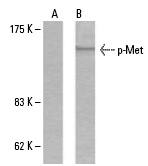
Blots were probed with p-Met (Tyr 1349): preincubated with its cognate phosphorylated peptide (A) and p-Met (Tyr 1349): (B).| Product Name | p-Met Antibody (Tyr 1349) |
|---|---|
| Antibody Type | Primary Antibodies |
| Antigen Alias | epitope corresponding to phosphorylated Tyr 1349 of Met of human origin |
| Modification | Phosphoralated |
| Modification Notes | The c-Met oncogene was originally isolated from a chemical carcinogen-treated human osteogenic sarcoma cell line by transfection analysis in NIH/3T3 cells. The Met proto-oncogene product was identified as a transmembrane receptor-like protein with tyrosine kinase activity that is expressed in many tissues. A high proportion of spontaneous NIH/3T3 transformants overexpress c-Met and by transfection analysis the c-Met proto-oncogene has been shown to exhibit transforming activity.Tyrosine phosphorylation of apparently normal Met protein has also been observed in certain human gastric carcinoma cell lines. Tyrosine phosphorylation enhances the receptor kinase activity, while serine phosphorylation of Met on residue 985 has an inhibitory effect. The c-Met gene product has been identified as the cell surface receptor for hepatocyte growth factor, a plasminogen-like protein thought to be a humoral mediator of liver regeneration. |
| Clonality | Polyclonal |
|---|---|
| Isotype | IgG |
| Host Species | Rabbit |
| Tested Applications | WBIP |
| recommended for detection of Tyr 1349 phosphorylated Met of human origin correspondingly phosphorylated Tyr 1347 of mouse origin and correspondingly phosphorylated Tyr 1350 of rat origin by WB and IP: |
|
| Species Reactivity | HumanMouseRat |
| Concentration | 1mg/ml |
| Purification | Affinity purified |
| Alternative Names | epitope corresponding to phosphorylated Tyr 1349 of Met of human origin |
|---|---|
| Tissue Specificity | epitope corresponding to phosphorylated Tyr 1349 of Met of human origin |
| Entrez Gene | 4233 |
|---|
Application
Blots were probed with p-Met (Tyr 1349): preincubated with its cognate phosphorylated peptide (A) and p-Met (Tyr 1349): (B).| Application Notes | recommended for detection of Tyr 1349 phosphorylated Met of human origin correspondingly phosphorylated Tyr 1347 of mouse origin and correspondingly phosphorylated Tyr 1350 of rat origin by WB and IP: |
|---|
| Form | Liquid |
|---|---|
| Storage Instructions | For short-term storage, store at 4° C. For long-term storage, aliquot and store at -20ºC or below. Avoid multiple freeze-thaw cycles. |
| Storage Buffer | phosphate buffered saline , pH 7.4, 150mM NaCl, 0.02% sodium azide and 50% glycerol. |


