Application
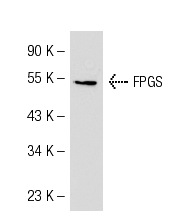
Western blot analysis of FPGS expression in U-698-M whole cell lysate.| Product Name | FPGS Antibody (H-105) |
|---|---|
| Antibody Type | Primary Antibodies |
| Antigen Alias | epitope corresponding to amino acids 177-281 mapping within an internal region of FPGS of human origin |
| Modification Notes | FPGS (folylpolyglutamate synthase) is a 587 amino acid protein that localizes to both the nucleus and the cytoplasm in an isoform-dependent manner and is involved in tetrahydrofolylpolyglutamate biosynthesis. Existing as a monomer, FPGS catalyzes the ATP-dependent conversion of folates to polyglutamate derivatives, thus allowing tissues to have a higher concentration of folate than the surrounding plasma. The gene encoding FPGS maps to human chromosome 9, which houses over 900 genes and comprises nearly 4% of the human genome. Hereditary hemorrhagic telangiectasia, which is characterized by harmful vascular defects, and Familial dysautonomia, are both associated with chromosome 9. Notably, chromosome 9 encompasses the largest interferon family gene cluster. |
| Clonality | Polyclonal |
|---|---|
| Isotype | IgG |
| Host Species | Rabbit |
| Tested Applications | WBIPIFELISA |
| recommended for detection of FPGS of mouse, rat and human origin by WB, IP, IF and ELISA also reactive with additional species, including equine, canine and bovine: |
|
| Species Reactivity | HumanMouseRat |
| Concentration | 1mg/ml |
| Purification | Affinity purified |
| Alternative Names | epitope corresponding to amino acids 177-281 mapping within an internal region of FPGS of human origin |
|---|---|
| Tissue Specificity | epitope corresponding to amino acids 177-281 mapping within an internal region of FPGS of human origin |
| Entrez Gene | 2356 |
|---|
Application
Western blot analysis of FPGS expression in U-698-M whole cell lysate.| Application Notes | recommended for detection of FPGS of mouse, rat and human origin by WB, IP, IF and ELISA also reactive with additional species, including equine, canine and bovine: |
|---|
| Form | Liquid |
|---|---|
| Storage Instructions | For short-term storage, store at 4° C. For long-term storage, aliquot and store at -20ºC or below. Avoid multiple freeze-thaw cycles. |
| Storage Buffer | phosphate buffered saline , pH 7.4, 150mM NaCl, 0.02% sodium azide and 50% glycerol. |


