Application
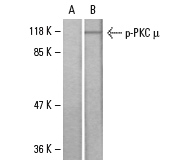
Western blot analysis of phosphorylated PKC μ expression in untreated (A) and EGF-treated (B) A431 whole cell lysates.| Product Name | p-PKC μ Antibody (Ser 910) |
|---|---|
| Antibody Type | Primary Antibodies |
| Antigen Alias | epitope corresponding to phosphorylated Ser 910 of PKC μ of human origin |
| Modification | Phosphoralated |
| Modification Notes | Members of the protein kinase C (PKC) family play a key regulatory role in a variety of cellular functions including cell growth and differentiation, gene expression, hormone secretion and membrane function. PKCs were originally identified as serine/threonine protein kinases whose activity was dependent on calcium and phospholipids. Diacylglycerols (DAG) and tumor promoting phorbol esters bind to and activate PKC. PKCs can be subdivided into many different isoforms (å, ∫I, ∫II, ©, ∂, é, Ω, h, †, λ/î, µ and n). Patterns of expression for each PKC isoform differ among tissues and PKC family members exhibit clear differences in their cofactor dependencies. For instance, the kinase activities of PKC ∂ and é are independent of Ca++. On the other hand, most of the other PKC members possess phorbol ester-binding activities and kinase activities. |
| Clonality | Polyclonal |
|---|---|
| Isotype | IgG |
| Host Species | Rabbit |
| Tested Applications | WBIP |
| recommended for detection of Ser 910 phosphorylated PKC µ of human origin and correspondingly phosphorylated Ser 916 of mouse and rat origin by WB and IP: |
|
| Species Reactivity | HumanMouseRat |
| Concentration | 1mg/ml |
| Purification | Affinity purified |
| Alternative Names | epitope corresponding to phosphorylated Ser 910 of PKC &mu of human origin |
|---|---|
| Tissue Specificity | epitope corresponding to phosphorylated Ser 910 of PKC μ of human origin |
| Entrez Gene | 5587 |
|---|
Application
Western blot analysis of phosphorylated PKC μ expression in untreated (A) and EGF-treated (B) A431 whole cell lysates.| Application Notes | recommended for detection of Ser 910 phosphorylated PKC µ of human origin and correspondingly phosphorylated Ser 916 of mouse and rat origin by WB and IP: |
|---|
| Form | Liquid |
|---|---|
| Storage Instructions | For short-term storage, store at 4° C. For long-term storage, aliquot and store at -20ºC or below. Avoid multiple freeze-thaw cycles. |
| Storage Buffer | phosphate buffered saline , pH 7.4, 150mM NaCl, 0.02% sodium azide and 50% glycerol. |


