Application
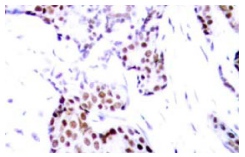
Immunoperoxidase staining of formalin-fixed, paraffin-embedded human breast carcinoma tissue showing nuclear localization.| Product Name | p-Elk-1 Antibody (Ser 389) |
|---|---|
| Antibody Type | Primary Antibodies |
| Antigen Alias | epitope corresponding to phosphorylated Ser 389 of Elk-1 of human origin |
| Modification | Phosphoralated |
| Modification Notes | Members of the Ets gene family exhibit varied patterns of tissue expression and share a highly conserved carboxy terminal domain containing a sequence related to the SV40 large T antigen nuclear localization signal sequence. This conserved domain is essential for Ets-1 binding to DNA and is likely responsible for the DNA binding activity of all members of the Ets gene family. ELK-1 is a 428 amino acid nuclear protein belonging to the Ets family. Expressed in lung and testis, ELK-1 stimulates transcription and binds to purine-rich DNA sequences. Upon mitogenic stimulation, ELK-1 is phosphorylated on C-terminal serine and threonine residues by MAPK1 (mitogen-activated protein kinase 1). Phosphorylation of ELK-1 leads to loss of SUMOylation and restores transcriptional activator activity. SUMOylation of ELK-1 results in recruitment of HDAC2 to target gene promoters, which leads to decreased histone acetylation and reduced transactivator activity. |
| Clonality | Polyclonal |
|---|---|
| Isotype | IgG |
| Host Species | Rabbit |
| Tested Applications | IFIHC |
| recommended for detection of Ser 389 phosphorylated Elk-1 of human origin, correspondingly phosphorylated Ser 390 of mouse origin and correspondingly phosphorylated Ser 388 of rat origin by IF and IHC(P): |
|
| Species Reactivity | HumanMouseRat |
| Concentration | 1mg/ml |
| Purification | Affinity purified |
| Alternative Names | epitope corresponding to phosphorylated Ser 389 of Elk-1 of human origin |
|---|---|
| Tissue Specificity | epitope corresponding to phosphorylated Ser 389 of Elk-1 of human origin |
| Entrez Gene | 2002 |
|---|
Application
Immunoperoxidase staining of formalin-fixed, paraffin-embedded human breast carcinoma tissue showing nuclear localization.| Application Notes | recommended for detection of Ser 389 phosphorylated Elk-1 of human origin, correspondingly phosphorylated Ser 390 of mouse origin and correspondingly phosphorylated Ser 388 of rat origin by IF and IHC(P): |
|---|
| Form | Liquid |
|---|---|
| Storage Instructions | For short-term storage, store at 4° C. For long-term storage, aliquot and store at -20ºC or below. Avoid multiple freeze-thaw cycles. |
| Storage Buffer | phosphate buffered saline , pH 7.4, 150mM NaCl, 0.02% sodium azide and 50% glycerol. |


