Application
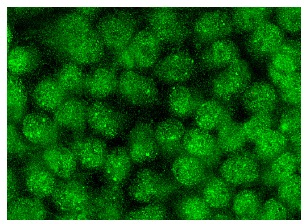
Immunofluorescence staining of methanol-fixed HeLa cells showing nuclear localization.Application
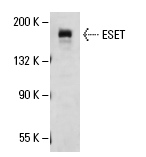
Western blot analysis of ESET expression in F9 whole cell lysate.| Product Name | ESET Antibody (H-300) |
|---|---|
| Antibody Type | Primary Antibodies |
| Antigen Alias | epitope corresponding to amino acids 1-300 mapping at the N-terminus of ESET of human origin |
| Modification Notes | ERG-associated protein with SET domain (ESET), also designated Histone H3-K9 methyltransferase 4 or SET domain bifurcated 1, is a nuclear protein belonging to the histone-lysine methyltransferase family and to the Suvar3-9 subfamily. It is a highly conserved protein of 150 amino acids that has been implicated in chromatin structure modulation. ESET is excluded from cell nucleoli and areas of condensed chromatin and can associate with the nonpericentromeric regions of chromatin. The gene encoding for this protein, SETDB1, maps to chromosome 1q21. ESET is a histone methyltransferase, methylating Lys-9 of histone H3 and mutations within the SETDB1 gene abolishes its methyltransferase activity. This methylation acts as a tag for epigenetic transcriptional repression by rounding up HP1 proteins to methylated histones. ESET is widely expressed with highest levels found in testis. |
| Clonality | Polyclonal |
|---|---|
| Isotype | IgG |
| Host Species | Rabbit |
| Tested Applications | WBIPIFELISAGSChIP |
| recommended for detection of ESET of mouse, rat and human origin by WB, IP, IF and ELISA also reactive with additional species, including equine, canine, bovine and porcine: |
|
| Species Reactivity | HumanMouseRat |
| Concentration | 1mg/ml |
| Purification | Affinity purified |
| Alternative Names | epitope corresponding to amino acids 1-300 mapping at the N-terminus of ESET of human origin |
|---|---|
| Tissue Specificity | epitope corresponding to amino acids 1-300 mapping at the N-terminus of ESET of human origin |
| Entrez Gene | 9869 |
|---|
Application
Immunofluorescence staining of methanol-fixed HeLa cells showing nuclear localization.
Application
Western blot analysis of ESET expression in F9 whole cell lysate.| Application Notes | recommended for detection of ESET of mouse, rat and human origin by WB, IP, IF and ELISA also reactive with additional species, including equine, canine, bovine and porcine: |
|---|
| Form | Liquid |
|---|---|
| Storage Instructions | For short-term storage, store at 4° C. For long-term storage, aliquot and store at -20ºC or below. Avoid multiple freeze-thaw cycles. |
| Storage Buffer | phosphate buffered saline , pH 7.4, 150mM NaCl, 0.02% sodium azide and 50% glycerol. |


