Application
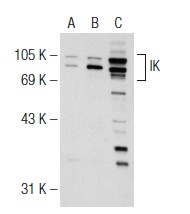
Western blot analysis of IK expression in non-transfected 293T: (A), mouse IK transfected 293T: (B) and K-562 (C) whole cell lysates.| Product Name | IK Antibody (T-13) |
|---|---|
| Antibody Type | Primary Antibodies |
| Antigen Alias | epitope mapping near the N-terminus of IK of human origin |
| Modification Notes | With 181 million base pairs encoding around 1,000 genes, chromosome 5 is about 6% of human genomic DNA. It is associated with Cockayne syndrome through the ERCC8 gene and familial adenomatous polyposis through the adenomatous polyposis coli (APC) tumor suppressor gene. Treacher Collins syndrome is also chromosome 5 associated and is caused by insertions or deletions within the TCOF1 gene. Deletion of the p arm of chromosome 5 leads to Cri du chat syndrome. Deletion of 5q or chromosome 5 altogether is common in therapy-related acute myelogenous leukemias and myelodysplastic syndrome. |
| Clonality | Polyclonal |
|---|---|
| Isotype | IgG |
| Host Species | Rabbit |
| Tested Applications | WBIPIFELISA |
| recommended for detection of IK of mouse, rat and human origin by WB, IP, IF and ELISA also reactive with additional species, including equine, canine, porcine and avian: |
|
| Species Reactivity | HumanMouseRat |
| Concentration | 1mg/ml |
| Purification | Affinity purified |
| Alternative Names | epitope mapping near the N-terminus of IK of human origin |
|---|---|
| Tissue Specificity | epitope mapping near the N-terminus of IK of human origin |
| Entrez Gene | 3550 |
|---|
Application
Western blot analysis of IK expression in non-transfected 293T: (A), mouse IK transfected 293T: (B) and K-562 (C) whole cell lysates.| Application Notes | recommended for detection of IK of mouse, rat and human origin by WB, IP, IF and ELISA also reactive with additional species, including equine, canine, porcine and avian: |
|---|
| Form | Liquid |
|---|---|
| Storage Instructions | For short-term storage, store at 4° C. For long-term storage, aliquot and store at -20ºC or below. Avoid multiple freeze-thaw cycles. |
| Storage Buffer | phosphate buffered saline , pH 7.4, 150mM NaCl, 0.02% sodium azide and 50% glycerol. |


