Application
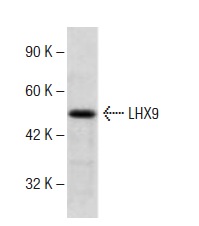
Western blot analysis of LHX9 expression in Jurkat whole cell lysate.| Product Name | LHX9 Antibody (S-23) |
|---|---|
| Antibody Type | Primary Antibodies |
| Modification Notes | During development, genetically distinct subtypes of motor neurons express unique combinations of LIM-type homeodomain factors, which regulate cell migration and guide motor axons to establish the fidelity of a binary choice in axonal trajectory. The LIM gene family encodes a set of gene products, which carry the LIM domain, a unique cysteine-rich zinc-binding domain. At least 40 members of this family have been identified in vertebrates and invertebrates, and are distributed into 4 groups according to the number of LIM domains and to the presence of homeodomains and kinase domains. The human LHX9 gene maps to chromosome 1q31-q32 and encodes a 388 amino acid protein. LHX9 is closely related to LHX2 and is expressed in the developing central nervous system. LHX9 influences the control of cell differentiation of several neural cell types and may act in a combinatorial manner with other LIM-homeodomain factors expressed in overlapping patterns. |
| Clonality | Polyclonal |
|---|---|
| Isotype | IgG |
| Host Species | Rabbit |
| Tested Applications | WBIPIFIHCELISA |
| Species Reactivity | HumanMouseRat |
| Concentration | 1mg/ml |
| Purification | Affinity purified |
| Alternative Names | recommended for detection of LHX9 of mouse rat human and zebrafish origin by WB IP IF IHC(P) and ELISA also reactive with additional species including canine |
|---|---|
| Tissue Specificity | recommended for detection of LHX9 of mouse, rat, human and zebrafish origin by WB, IP, IF, IHC(P) and ELISA; also reactive with additional species, including canine |
| Entrez Gene | 56956 |
|---|
Application
Western blot analysis of LHX9 expression in Jurkat whole cell lysate.| Form | Liquid |
|---|---|
| Storage Instructions | For short-term storage, store at 4° C. For long-term storage, aliquot and store at -20ºC or below. Avoid multiple freeze-thaw cycles. |
| Storage Buffer | phosphate buffered saline , pH 7.4, 150mM NaCl, 0.02% sodium azide and 50% glycerol. |


