Application
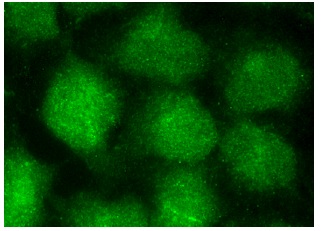
Immunofluorescence staining of methanol-fixed HeLa cells showing nuclear and cytoplasmic localization.Application
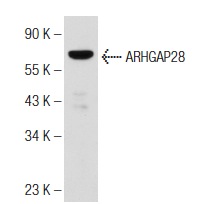
Western blot analysis of ARHGAP28 expression in NTERA-2 cl.D2 whole cell lysate.| Product Name | ARHGAP28 Antibody (S-14) |
|---|---|
| Antibody Type | Primary Antibodies |
| Modification Notes | ARHGAP28 (rho GTPase activating protein 28), also known as KIAA1314, is a 729 amino acid protein that contains one helical Rho-GAP domain. Expressed at moderate levels in ovary and kidney and at lower levels in skeletal muscle and spleen, ARHGAP28 functions as a negative regulator of Rho-type GTPases, specifically catalyzing the conversion of the target GTPase to an inactive, GDP-bound state. ARHGAP28, which exists as four alternatively spliced isoforms, is subject to DNA damaged-induced phosphorylation, possibly by ATM or ATR. The gene encoding ARHGAP28 localizes to human chromosome 18, which houses over 300 protein-coding genes and contains nearly 76 million bases. There are a variety of diseases associated with defects in chromosome 18-localized genes, some of which include Trisomy 18 (also known as Edwards syndrome), Niemann-Pick disease, hereditary hemorrhagic telangiectasia, erythropoietic protoporphyria and follicular lymphomas. |
| Clonality | Polyclonal |
|---|---|
| Isotype | IgG |
| Host Species | Rabbit |
| Tested Applications | WBIPIFELISA |
| recommended for detection of ARHGAP28 of mouse, rat and human origin by WB, IP, IF and ELISA non cross-reactive with ARHGAP10 and ARHGAP21. also reactive with additional species, including equine | |
| Species Reactivity | HumanMouseRat |
| Concentration | 1mg/ml |
| Purification | Affinity purified |
| Alternative Names | epitope mapping within an internal region of ARHGAP28 of human origin |
|---|---|
| Tissue Specificity | epitope mapping within an internal region of ARHGAP28 of human origin |
| Entrez Gene | 79822 |
|---|
Application
Immunofluorescence staining of methanol-fixed HeLa cells showing nuclear and cytoplasmic localization.
Application
Western blot analysis of ARHGAP28 expression in NTERA-2 cl.D2 whole cell lysate.| Application Notes | recommended for detection of ARHGAP28 of mouse, rat and human origin by WB, IP, IF and ELISA non cross-reactive with ARHGAP10 and ARHGAP21. also reactive with additional species, including equine |
|---|
| Form | Liquid |
|---|---|
| Storage Instructions | For short-term storage, store at 4° C. For long-term storage, aliquot and store at -20ºC or below. Avoid multiple freeze-thaw cycles. |
| Storage Buffer | phosphate buffered saline , pH 7.4, 150mM NaCl, 0.02% sodium azide and 50% glycerol. |


