Application
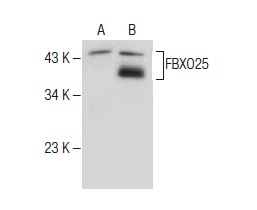
Western blot analysis of FBXO25 expression in non-transfected: (A) and human FBXO25 transfected: (B) 293T whole cell lysates.| Product Name | FBXO25 Antibody (C-19) |
|---|---|
| Antibody Type | Primary Antibodies |
| Modification Notes | FBXO25 (F-box only protein 25), also known as FBX25, is a 367 amino acid protein that contains one C-terminal F-box domain and belongs to the Fbx class of the F-box family of proteins. F-box proteins are critical components of the SCF (Skp1-CUL-1-F-box protein) type E3 ubiquitin ligase complex and are involved in substrate recognition and recruitment for ubiquitination. They are members of a larger family of proteins that are involved in the regulation of a wide variety of cellular processes (including the cell cycle, immune response, signaling cascades and developmental processes) through the targeting of proteins, such as cyclins, cyclin-dependent kinase inhibitors, IkB-a and b-catenin, for degradation by the proteasome after ubiquitination. Expressed at high levels in brain, FBXO25 localizes predominantly to the nucleus and directly interacts with Skp1 p19 and CUL-1. Disruption of the gene encoding FBXO25 can lead to X-linked mental retardation. |
| Clonality | Polyclonal |
|---|---|
| Isotype | IgG |
| Host Species | Rabbit |
| Tested Applications | WBIPIFELISA |
| recommended for detection of FBXO25 of mouse, rat and human origin by WB, IP, IF and ELISA non cross-reactive with other FBXO family members also reactive with additional species, including equine, canine and bovine | |
| Species Reactivity | HumanMouseRat |
| Concentration | 1mg/ml |
| Purification | Affinity purified |
| Alternative Names | epitope mapping near the C-terminus of FBXO25 of human origin |
|---|---|
| Tissue Specificity | epitope mapping near the C-terminus of FBXO25 of human origin |
| Entrez Gene | 26260 |
|---|
Application
Western blot analysis of FBXO25 expression in non-transfected: (A) and human FBXO25 transfected: (B) 293T whole cell lysates.| Application Notes | recommended for detection of FBXO25 of mouse, rat and human origin by WB, IP, IF and ELISA non cross-reactive with other FBXO family members also reactive with additional species, including equine, canine and bovine |
|---|
| Form | Liquid |
|---|---|
| Storage Instructions | For short-term storage, store at 4° C. For long-term storage, aliquot and store at -20ºC or below. Avoid multiple freeze-thaw cycles. |
| Storage Buffer | phosphate buffered saline , pH 7.4, 150mM NaCl, 0.02% sodium azide and 50% glycerol. |


