Application
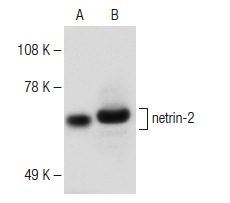
Western blot analysis of netrin-2 expression in HEK293 (A) and Y79 (B) whole cell lysates.Application
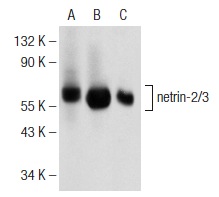
Western blot analysis of netrin-2/3 expression in mouse embryo (A), human platelet (B) and mouse lymph node (C) tissue extracts.| Product Name | netrin-2 Antibody (H-50) |
|---|---|
| Antibody Type | Primary Antibodies |
| Modification Notes | Netrin proteins are a family of laminin-related secreted proteins that provide guidance signals for axonal growth and cell migration during development (1). Netrin-1, which is the mammalian homolog of UNC-6 from C. elegans, is largely expressed in the developing nervous system and in mesodermal tissues (2). Netrin-1 is expressed by the floor plate as either a cell associated protein or in a diffusible form, and it binds to several surface receptor components, including deleted in colorectal cancer (DCC) and neogenin (3). During embryonic development, netrin-1 diffuses through the neuronal epithelium, where it forms a chemoattractant gradient that directs axonal migration to the ventral midline of the spinal cord (4). Netrin-2 and the corresponding mouse homolog netrin-3 are expressed primarily in the lower two-thirds of the spinal cord, and, like netrin-1, they can either attract or repel commissural axons at a distance (5,6). Netrin signaling is dependent on the concentration of calcium outside the cell and the level of PKA activity. In axonal cells, a reduction in PKA activity converts the responsiveness of the axons to the netrin proteins, as the cells are repelled, rather than attracted, by the netrin gradient (7). |
| Clonality | Polyclonal |
|---|---|
| Isotype | IgG |
| Host Species | Rabbit |
| Tested Applications | WBIPIFELISA |
| recommended for detection of netrin-2 of human origin and netrin-3 of mouse and rat origin of mouse, rat and human origin by WB, IP, IF and ELISA also reactive with additional species, including canine, bovine and porcine | |
| Species Reactivity | HumanMouseRat |
| Concentration | 1mg/ml |
| Purification | Affinity purified |
| Alternative Names | epitope corresponding to amino acids 467-526 mapping near the C-terminus of netrin-2 of human origin |
|---|---|
| Tissue Specificity | epitope corresponding to amino acids 467-526 mapping near the C-terminus of netrin-2 of human origin |
| Entrez Gene | 4917 |
|---|
Application
Western blot analysis of netrin-2 expression in HEK293 (A) and Y79 (B) whole cell lysates.
Application
Western blot analysis of netrin-2/3 expression in mouse embryo (A), human platelet (B) and mouse lymph node (C) tissue extracts.| Application Notes | recommended for detection of netrin-2 of human origin and netrin-3 of mouse and rat origin of mouse, rat and human origin by WB, IP, IF and ELISA also reactive with additional species, including canine, bovine and porcine |
|---|
| Form | Liquid |
|---|---|
| Storage Instructions | For short-term storage, store at 4° C. For long-term storage, aliquot and store at -20ºC or below. Avoid multiple freeze-thaw cycles. |
| Storage Buffer | phosphate buffered saline , pH 7.4, 150mM NaCl, 0.02% sodium azide and 50% glycerol. |


