Application
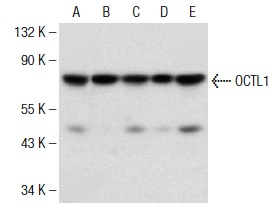
Western blot analysis of OCTL1 expression in A-431 (A), KNRK (B), HL-60 (C), Hep G2 (D) and HeLa (E) whole cell lysates.| Product Name | OCTL1 Antibody (K-13) |
|---|---|
| Antibody Type | Primary Antibodies |
| Modification Notes | Organic cations, such as quaternary ammoniums, are a group of compounds that carry a positive charge. OCTL1 (Organic cation transporter-like 3), also known as SLC22A13, OCTL3 or ORCTL3, belongs to the major facilitator superfamily which includes the organic cation transport family. OCTL1 is a conserved 551 amino acid transmembrane protein that has a fundamental role in mammalian systems. OCTL1 functions in the uptake of catecholamines and neurotoxic organic cations. Organic cation transport is essential for drug absorption, targeting and deposition. OCTL1 is highly expressed in glial cells and kidney tissue, and is ubiquitously expressed at low levels in all other tissues. |
| Clonality | Polyclonal |
|---|---|
| Isotype | IgG |
| Host Species | Rabbit |
| Tested Applications | WBIPIFELISA |
| recommended for detection of OCTL1 of mouse, rat and human origin by WB, IP, IF and ELISA also reactive with additional species, including canine and porcine | |
| Species Reactivity | HumanMouseRat |
| Concentration | 1mg/ml |
| Purification | Affinity purified |
| Alternative Names | epitope mapping within a cytoplasmic domain of OCTL1 of human origin |
|---|---|
| Tissue Specificity | epitope mapping within a cytoplasmic domain of OCTL1 of human origin |
| Entrez Gene | 9390 |
|---|
Application
Western blot analysis of OCTL1 expression in A-431 (A), KNRK (B), HL-60 (C), Hep G2 (D) and HeLa (E) whole cell lysates.| Application Notes | recommended for detection of OCTL1 of mouse, rat and human origin by WB, IP, IF and ELISA also reactive with additional species, including canine and porcine |
|---|
| Form | Liquid |
|---|---|
| Storage Instructions | For short-term storage, store at 4° C. For long-term storage, aliquot and store at -20ºC or below. Avoid multiple freeze-thaw cycles. |
| Storage Buffer | phosphate buffered saline , pH 7.4, 150mM NaCl, 0.02% sodium azide and 50% glycerol. |


