Application
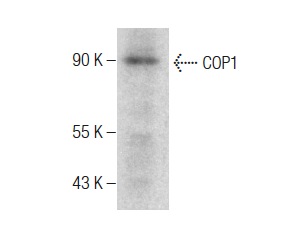
Western blot analysis of COP1 expression in JAR whole cell lysate.| Product Name | COP1 Antibody (H-300) |
|---|---|
| Antibody Type | Primary Antibodies |
| Modification Notes | COP1 (Constitutive photomorphogenesis protein 1), also designated RFWD2 (ring finger and WD repeat domain 2) or RNF200 (ring finger protein 200), is an E3 ubiquitin ligase protein that mediates ubiquitination and degradation of target proteins such as c-Jun and p53. It is a component of the DCX DET1-COP1 ubiquitin ligase complex which consists of RBX1, DET1, DDB1, CUL4A and COP1. Localizing to the cytoplasm and to the nucleus, COP1 is primarily expressed in testis, placenta, heart and skeletal muscle. COP1 is a potent inhibitor of p53-dependent transcription and apoptosis but, when phosphorylated by Atm (ataxia telangiectasia mutated) in response to DNA damage, the COP1-p53 complex is disrupted and p53 is allowed to exert its pro-apoptotic properties. In ovarian and breast cancers, COP1 is overexpressed, suggesting a role for COP1 in tumorigenesis. |
| Clonality | Polyclonal |
|---|---|
| Isotype | IgG |
| Host Species | Rabbit |
| Tested Applications | WBIPIFELISAGSChIP |
| recommended for detection of COP1 of mouse, rat and human origin by WB, IP, IF and ELISA also reactive with additional species, including equine, canine, bovine and avian | |
| Species Reactivity | HumanMouseRat |
| Concentration | 1mg/ml |
| Purification | Affinity purified |
| Alternative Names | epitope corresponding to amino acids 432-731 mapping at the C-terminus of COP1 of human origin |
|---|---|
| Tissue Specificity | epitope corresponding to amino acids 432-731 mapping at the C-terminus of COP1 of human origin |
| Entrez Gene | 64326 |
|---|
Application
Western blot analysis of COP1 expression in JAR whole cell lysate.| Application Notes | recommended for detection of COP1 of mouse, rat and human origin by WB, IP, IF and ELISA also reactive with additional species, including equine, canine, bovine and avian |
|---|
| Form | Liquid |
|---|---|
| Storage Instructions | For short-term storage, store at 4° C. For long-term storage, aliquot and store at -20ºC or below. Avoid multiple freeze-thaw cycles. |
| Storage Buffer | phosphate buffered saline , pH 7.4, 150mM NaCl, 0.02% sodium azide and 50% glycerol. |


