Application
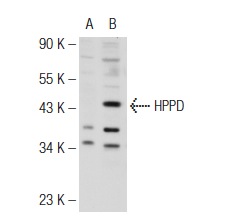
Western blot analysis of HPPD expression in non-transfected: (A) and mouse HPPD transfected: (B) 293T whole cell lysates.Application
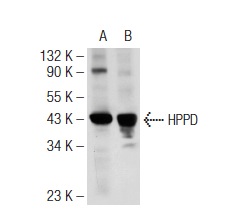
Western blot analysis of HPPD expression in mouse liver (A) and rat liver (B) tissue extracts.| Product Name | HPPD Antibody (H-300) |
|---|---|
| Antibody Type | Primary Antibodies |
| Modification Notes | HPPD (4-hydroxyphenylpyruvate dioxygenase), also known as PPD, GLOD3 or HPD, is a 393 amino acid protein that belongs to the 4HPPD family and is involved in amino acid degradation. Existing as a homodimer, HPPD uses zinc as a cofactor to catalyze the third step in the conversion of L-phenylalanine to fumarate and acetoacetic acid. Defects in the gene encoding HPPD are the cause of tyrosinemia type 3 (TYRO3) and hawkinsinuria (HAWK), both of which are inborn errors of metabolism that are associated with a variety of symptoms, including mental retardation and seizures (associated with TYRO3) and hair and urine abnormalities (associated with HAWK). The gene encoding HPPD maps to human chromosome 12, which encodes over 1,100 genes and comprises approximately 4.5% of the human genome. |
| Clonality | Polyclonal |
|---|---|
| Isotype | IgG |
| Host Species | Rabbit |
| Tested Applications | WBIPIFELISA |
| recommended for detection of HPPD of mouse, rat and human origin by WB, IP, IF and ELISA also reactive with additional species, including equine, canine and bovine | |
| Species Reactivity | HumanMouseRat |
| Concentration | 1mg/ml |
| Purification | Affinity purified |
| Alternative Names | epitope corresponding to amino acids 1-300 mapping at the N-terminus of HPPD of human origin |
|---|---|
| Tissue Specificity | epitope corresponding to amino acids 1-300 mapping at the N-terminus of HPPD of human origin |
| Entrez Gene | 3242 |
|---|
Application
Western blot analysis of HPPD expression in non-transfected: (A) and mouse HPPD transfected: (B) 293T whole cell lysates.
Application
Western blot analysis of HPPD expression in mouse liver (A) and rat liver (B) tissue extracts.| Application Notes | recommended for detection of HPPD of mouse, rat and human origin by WB, IP, IF and ELISA also reactive with additional species, including equine, canine and bovine |
|---|
| Form | Liquid |
|---|---|
| Storage Instructions | For short-term storage, store at 4° C. For long-term storage, aliquot and store at -20ºC or below. Avoid multiple freeze-thaw cycles. |
| Storage Buffer | phosphate buffered saline , pH 7.4, 150mM NaCl, 0.02% sodium azide and 50% glycerol. |


