Application
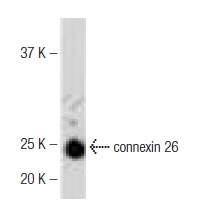
Western blot analysis of connexin 26 expression in mouse brain tissue extract.Application
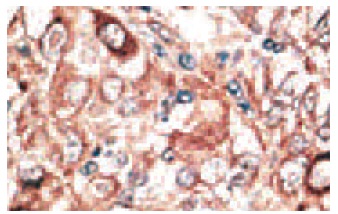
Immunoperoxidase staining of formalin-fixed, paraffin-embedded human hepatocarcinoma tissue showing cytoplasmic and membrane localization.| Product Name | connexin 26 Antibody (O-24) |
|---|---|
| Antibody Type | Primary Antibodies |
| Modification Notes | The connexin family of proteins form hexameric complexes called “connexons” that facilitate movement of low molecular weight proteins between cells via gap junctions. Connexin proteins share a common topology of 4 transmembrane alpha-helical domains, two extracellular loops, a cytoplasmic loop, and cytoplasmic N- and C-termini. Each of the approximately 20 connexin isoforms produces channels with distinct permeabilities and electrical and chemical sensitivities; therefore, one connexin usually cannot fully substitute for another. Consequently, a wide variety of malignant phenotypes associate with decreased connexin expression and gap junction communication, dependent on the particular connexin that is effected. Approximately half the cases of autosomal recessive non-syndromic hearing loss and a significant proportion of sporadic hearing loss can be linked to mutations in the gene encoding connexin 26, while mutations in the gene encoding connexin 32 are the cause of Charcot-Marie-Tooth disease. Defects in the gene encoding connexin 30 are the cause of ectodermal dysplasia type 2 (ED2) and non-syndromatic sensorineural deafness autosomal dominant type 3 (DFNA3), the former of which is characterized by abnormal development of ectodermal structures (such as skin and nails). |
| Clonality | Polyclonal |
|---|---|
| Isotype | IgG |
| Host Species | Rabbit |
| Tested Applications | WBIPIFIHCELISA |
| Species Reactivity | HumanMouseRat |
| Concentration | 1mg/ml |
| Purification | Affinity purified |
| Alternative Names | recommended for detection of connexin 26 of mouse and human origin by WB IP IF IHC(P) and ELISA |
|---|---|
| Tissue Specificity | recommended for detection of connexin 26 of mouse and human origin by WB, IP, IF, IHC(P) and ELISA |
| Entrez Gene | 2706 |
|---|
Application
Western blot analysis of connexin 26 expression in mouse brain tissue extract.
Application
Immunoperoxidase staining of formalin-fixed, paraffin-embedded human hepatocarcinoma tissue showing cytoplasmic and membrane localization.| Form | Liquid |
|---|---|
| Storage Instructions | For short-term storage, store at 4° C. For long-term storage, aliquot and store at -20ºC or below. Avoid multiple freeze-thaw cycles. |
| Storage Buffer | phosphate buffered saline , pH 7.4, 150mM NaCl, 0.02% sodium azide and 50% glycerol. |


