Application
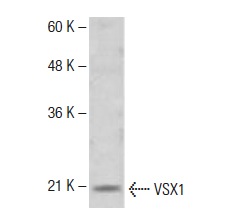
Western blot analysis of VSX1 expression in Jurkat whole cell lysate.| Product Name | VSX1 Antibody (P-25) |
|---|---|
| Antibody Type | Primary Antibodies |
| Modification Notes | Like other ‘paired-like’ homeodomain family members, the visual system homeobox gene 1 (VSX1) is instrumental in craniofacial and ocular development; VSX1 plays a distinct role in retinal development (1, 2). Also known as RINX (retinal inner nuclear layer homeobox), the VSX1 gene is expressed in embryonic craniofacial structures and in the adult retina (1). VSX1 is abundantly expressed in the inner nuclear layer (INL) of the retina (2). In mice, Vsx1 first detected in the bipolar cells of the retina five days postnatal (2, 3, 4). The VSX1 gene is also expressed in WERI, a retinoblastoma cell line that expresses retinal cone genes (3). The human VSX1 gene maps to chromosome 20p11.21 and encodes a 365 amino acid protein with five known splice variants (5, 3). VSX1 mutations are implicated in two distinct corneal dystrophies, posterior polymorphous dystrophy (PPD) and keratoconus (2). |
| Clonality | Polyclonal |
|---|---|
| Isotype | IgG |
| Host Species | Rabbit |
| Tested Applications | WBIPELISA |
| Species Reactivity | HumanMouseRat |
| Concentration | 1mg/ml |
| Purification | Affinity purified |
| Alternative Names | recommended for detection of VSX1 of human origin by WB IP and ELISA |
|---|---|
| Tissue Specificity | recommended for detection of VSX1 of human origin by WB, IP and ELISA |
| Entrez Gene | 30813 |
|---|
Application
Western blot analysis of VSX1 expression in Jurkat whole cell lysate.| Form | Liquid |
|---|---|
| Storage Instructions | For short-term storage, store at 4° C. For long-term storage, aliquot and store at -20ºC or below. Avoid multiple freeze-thaw cycles. |
| Storage Buffer | phosphate buffered saline , pH 7.4, 150mM NaCl, 0.02% sodium azide and 50% glycerol. |


