Application
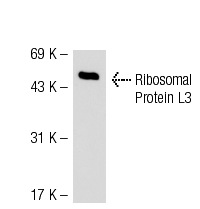
Western blot analysis of Ribosomal Protein L3 expression in K-562 whole cell lysate.Application
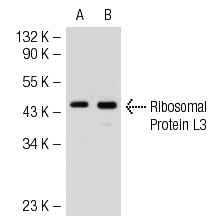
Western blot analysis of Ribosomal Protein L3 expression in 293T (A) and U-698-M (B) whole cell lysates.| Product Name | Ribosomal Protein L3 Antibody (K-12) |
|---|---|
| Antibody Type | Primary Antibodies |
| Modification Notes | Ribosomes, the organelles that catalyze protein synthesis, are composed of a small subunit (40S) and a large subunit (60S) that consist of over 80 distinct ribosomal proteins. Mammalian ribosomal proteins are encoded by multigene families that contain processed pseudogenes and one functional intron-containing gene within their coding regions. Ribosomal Protein L3, also known as RPL3 or TARBP-B, is a 403 amino acid protein that localizes to the cytoplasm and belongs to the L3P family of ribosomal proteins. Expressed as multiple alternatively spliced isoforms, Ribosomal Protein L3 is able to bind to HIV-1 mRNA, possibly activating HIV-1 protein translation. Like most ribosomal proteins, Ribosomal Protein L3 exists as multiple processed pseudogenes that are scattered throughout the genome. |
| Clonality | Polyclonal |
|---|---|
| Isotype | IgG |
| Host Species | Rabbit |
| Tested Applications | WBIPIFELISA |
| recommended for detection of Ribosomal Protein L3 of mouse, rat and human origin by WB, IP, IF and ELISA non cross-reactive with other Ribosomal Protein family members also reactive with additional species, including equine, canine, bovine and porcine | |
| Species Reactivity | HumanMouseRat |
| Concentration | 1mg/ml |
| Purification | Affinity purified |
| Alternative Names | epitope mapping within an internal region of Ribosomal Protein L3 of human origin |
|---|---|
| Tissue Specificity | epitope mapping within an internal region of Ribosomal Protein L3 of human origin |
| Entrez Gene | 6122 |
|---|
Application
Western blot analysis of Ribosomal Protein L3 expression in K-562 whole cell lysate.
Application
Western blot analysis of Ribosomal Protein L3 expression in 293T (A) and U-698-M (B) whole cell lysates.| Application Notes | recommended for detection of Ribosomal Protein L3 of mouse, rat and human origin by WB, IP, IF and ELISA non cross-reactive with other Ribosomal Protein family members also reactive with additional species, including equine, canine, bovine and porcine |
|---|
| Form | Liquid |
|---|---|
| Storage Instructions | For short-term storage, store at 4° C. For long-term storage, aliquot and store at -20ºC or below. Avoid multiple freeze-thaw cycles. |
| Storage Buffer | phosphate buffered saline , pH 7.4, 150mM NaCl, 0.02% sodium azide and 50% glycerol. |


