Application
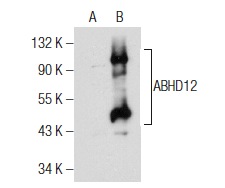
Western blot analysis of ABHD12 expression in non-transfected: (A) and human ABHD12 transfected: (B) 293T whole cell lysates.| Product Name | ABHD12 Antibody (N-15) |
|---|---|
| Antibody Type | Primary Antibodies |
| Modification Notes | The å/∫ hydrolase superfamily comprise diverse members that are involved in important biochemical processes and related to various diseases. They have unrelated sequences, various substrates, and different kinds of catalytic activities, yet they share the same canonical å/∫ hydrolase fold, which consists of an eight stranded parallel å/∫ structure. They are also characterized by a catalytic triad composed of a histidine, an acid and a nucleophile. Members of this superfamily are often drug targets for treating diseases, such as diabetes, Alzheimer’s disease, obesity and blood clotting disorders. The Abhydrolase domain containing (ABHD) gene subfamily is comprised of 15 mostly uncharacterized members. Most of which utilize a serine nucleophile to form the G-X-S-X-G nucleophile elbow. ABHD1 plays a role in metabolizing smoking xenobiotics. ABHD2 participates in the development of atherosclerosis. ABHD4 is involved in an alternative synthesis pathway of NAE. Mutations in ABHD5 contribute to Chanarin-Dorfman syndrome. ABDH6 may play a role in nervous system metabolism and signaling. ABHD12 is a 398 amino acid protein that exists as two alternatively spliced isoforms. |
| Clonality | Polyclonal |
|---|---|
| Isotype | IgG |
| Host Species | Rabbit |
| Tested Applications | WBIPIFELISA |
| recommended for detection of ABHD12 of mouse, rat and human origin by WB, IP, IF and ELISA non cross-reactive with ABHD3, ABHD4, and ABHD13 also reactive with additional species, including canine and bovine | |
| Species Reactivity | HumanMouseRat |
| Concentration | 1mg/ml |
| Purification | Affinity purified |
| Alternative Names | epitope mapping at the N-terminus of ABHD12 of human origin |
|---|---|
| Tissue Specificity | epitope mapping at the N-terminus of ABHD12 of human origin |
| Entrez Gene | 26090 |
|---|
Application
Western blot analysis of ABHD12 expression in non-transfected: (A) and human ABHD12 transfected: (B) 293T whole cell lysates.| Application Notes | recommended for detection of ABHD12 of mouse, rat and human origin by WB, IP, IF and ELISA non cross-reactive with ABHD3, ABHD4, and ABHD13 also reactive with additional species, including canine and bovine |
|---|
| Form | Liquid |
|---|---|
| Storage Instructions | For short-term storage, store at 4° C. For long-term storage, aliquot and store at -20ºC or below. Avoid multiple freeze-thaw cycles. |
| Storage Buffer | phosphate buffered saline , pH 7.4, 150mM NaCl, 0.02% sodium azide and 50% glycerol. |


